
Book of Joel - Chapter 3
In this powerful conclusion to our study on the book of Joel, we dive into Chapter 3 to explore the profound themes of divine justice, human free will, and God's ultimate sovereignty. Discover how God’s incredible patience serves as a lingering invitation to turn back to Him, and find comfort in His promise of overflowing provision and refuge for His people. Join us as we look at how the terrors of judgment give way to the beautiful redemption made possible through the ultimate sacrifice of Jesus Christ.
Chapters:
0:00 - Introduction to Joel Chapter 3 and Context
2:30 - God's Judgment on Nations
6:26 - The Human Desire for God's Justice
10:19 - God's Retribution on Specific Nations
12:38 - God's Justice is Inevitable
15:21 - Call to War: The Lord's Judgment Day
16:29 - The Patience and Power of God
22:33 - God's Refuge and Abundant Provision
Deep Dive Podcast
Joel Chapter 3: Divine Judgment and Restoration Study Guide
This study guide provides a comprehensive overview of the theological and practical themes found in the sermon regarding Joel Chapter 3. It explores the complexities of divine justice, the patience of God, and the ultimate promise of restoration for His people.
Content Overview: Key Theological Themes
1. Sovereignty and Human Agency
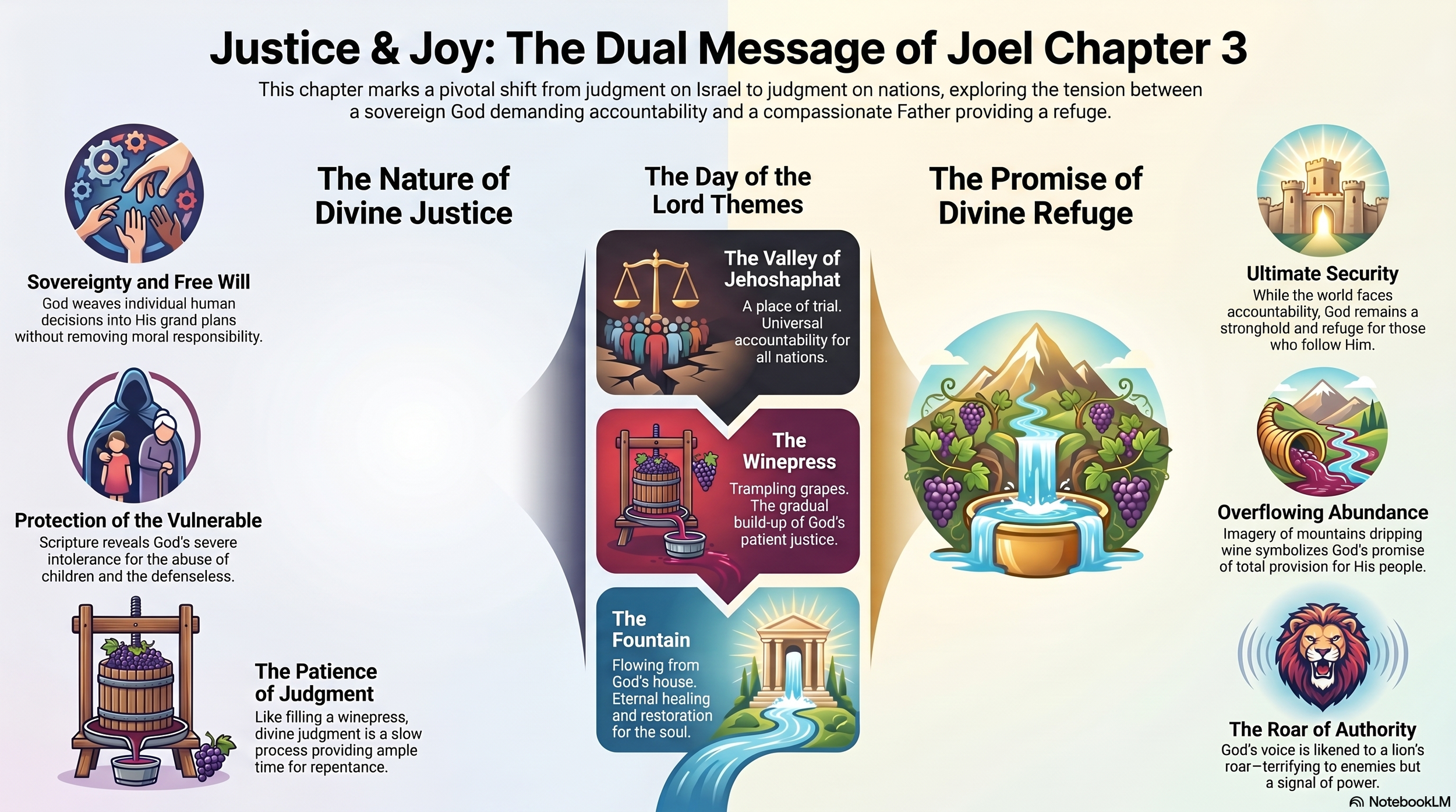
The sermon addresses the complex interplay between God's total sovereignty and human free will. It posits that God does not force actions simply to punish individuals; rather, He weaves human decisions, made of their own volition, into His grand purposes and plans. Humans remain responsible for their choices even as those choices are utilized to accomplish divine ends.
2. The Universality of Accountability
While the historical context of Joel focuses on the nation of Israel, the sermon expands this to include modern Christians. The "Valley of Jehoshaphat" is identified not as a literal geographic location but as symbolic language representing a place of universal accountability where all nations will be held responsible for their treatment of God's people.
3. The Innate Desire for Justice
A central argument of the text is that all humans are fundamentally wired to desire justice. Using historical examples like Hitler and the structure of modern judicial systems, the sermon suggests that humanity naturally craves a God who judges wrongdoing. Divine judgment is presented not as a point of fear alone, but as the fulfillment of a deep-seated human longing for things to be made right.
4. Protection of the Vulnerable
The text highlights God’s severe intolerance for the abuse of those who cannot defend themselves, specifically children and the defenseless. This is presented as a "moral threshold"; while God is patient, the exploitation of the "least of these" often triggers swift divine intervention.
5. Divine Patience and the "Winepress"
Using the metaphor of trampling grapes in a winepress, the sermon illustrates that divine judgment is a slow, deliberate process rather than a rash reaction. This process demonstrates God’s immense patience, providing ample opportunity for repentance—as seen in the 400 years of Egyptian captivity—before a moral threshold is crossed and the "vat" overflows.
6. Majesty vs. Security
The sermon contrasts the terrifying majesty of God—likened to the visceral, guttural roar of a lion—with the profound refuge He provides. For those who oppose Him, His authority is a source of dread; for His followers, He is a stronghold and a source of overflowing abundance.
Short-Answer Quiz
Instructions: Answer the following questions in 2-3 sentences based on the provided text.
What is the symbolic significance of the "Valley of Jehoshaphat"?
How does the sermon reconcile God's use of foreign nations to punish Israel with His subsequent judgment of those same nations?
According to the text, what specific actions did the foreign nations take that provoked God's judgment?
How does the sermon use the example of the American judicial system to explain human nature?
What is the "moral threshold" mentioned in relation to God's patience?
Why does the speaker use the historical examples of Roman Emperors like Nero and Maximus?
What does the "roar of God from Zion" represent in the context of Joel 3?
How is the future provision for God's people described metaphorically in the text?
What is the significance of the "fountain flowing out of the Lord's house"?
How does the sermon connect the Old Testament theme of "innocent blood" to the New Testament?
Quiz Answer Key
The Valley of Jehoshaphat: There is no literal geographic "Valley of Jehoshaphat." It is symbolic language used to describe a place of universal accountability where God gathers the nations to be held responsible for their actions against His people.
Sovereignty and Free Will: The sermon explains that God weaves human decisions, made of their own volition, into His grand plan. He does not force actions just to punish them, but utilizes the choices people make to accomplish His divine purposes.
Provocations for Judgment: The nations were judged for scattering God's people, dividing His land, and selling children into slavery for wine and prostitutes. Additionally, they took silver and gold from God’s temples to place in their own foreign temples.
The Judicial System: The sermon argues that the US judicial system reflects our innate wiring for justice, as we insist on individual trials for every crime (such as multiple murders). This demonstrates a fundamental human desire for comprehensive justice, which mirrors God's character.
Moral Threshold: This refers to the point where human wickedness, particularly the abuse of children and the defenseless, reaches a level that God will no longer tolerate. The winepress metaphor shows that while God is patient, judgment eventually overflows once this threshold is crossed.
Roman Emperors: These examples are used to show the historical certainty of divine justice. Even though the Romans persecuted early Christians, their leaders eventually faced miserable ends and their empire fell, proving that God eventually answers the "when" of justice.
The Roar of God: The roar represents God’s absolute authority and power, creating a visceral response of submission. It suggests that when God finally asserts His authority, no further battle is necessary because His power is overwhelming.
Metaphors of Provision: The text describes mountains dripping with new wine and hills flowing with milk. This imagery represents total, overflowing abundance and the promise that God will eventually provide for every soul-deep need of His followers.
The Fountain: The fountain flowing from the Lord’s house symbolizes the continuous, life-giving restoration and healing that God provides. It serves as a promise of future restoration where the brokenness of the world is finally set right.
Innocent Blood: The sermon notes that while God promises to avenge the innocent blood of the oppressed, He also allowed the innocent blood of His Son, Jesus Christ, to be shed. This sacrifice provides the means for the unrighteous to be forgiven and redeemed.
Essay Questions
The following questions are designed for deeper reflection and do not include provided answers.
Analyze the Dual Nature of God's Character: Discuss how Joel Chapter 3 balances the "terrifying majesty" of divine judgment with the "ultimate security" of God as a refuge. How do these two seemingly opposite traits function together in the text?
The Ethics of Justice: Explore the sermon's argument that humanity is "wired for justice." How does the speaker use historical and modern examples to defend the necessity of a God who judges, and how does this challenge common critiques of "judgmental" religion?
Metaphorical Language in Prophecy: Examine the use of the winepress, the lion’s roar, and the dripping mountains in the sermon. How do these metaphors communicate complex theological truths more effectively than literal descriptions?
The Concept of "The Least of These": Based on the sermon, evaluate the church's responsibility toward the vulnerable. How does God’s reaction to the treatment of children in Joel 3 serve as a "call to action" for contemporary believers?
Divine Patience vs. Human Timelines: Using the historical example of the 400-year Egyptian captivity, discuss the sermon's perspective on God's timing. How should the "patience of the winepress" influence a believer’s perspective on current world injustices?
Glossary of Key Terms
Day of the Lord: A recurring scriptural theme referring to a specific time of divine intervention, judgment, and the restoration of God's people.
Innocent Blood: A term referring to the harm or death of those who are defenseless or have done no wrong; the text emphasizes that God will not leave such acts unavenged.
Jehoshaphat (Valley of): Symbolic language for a place where all nations are gathered for trial and held accountable by God.
Moral Threshold: The point at which human sin and abuse reach a level that triggers God’s active judgment after a period of patience.
Pace of Pacing: The deliberate, slow process of divine justice, often contrasted with human desires for immediate retribution.
Refuge: The role of God as a stronghold or safe place for His followers amidst the terrors of judgment.
Restoration: The act of returning fortunes, healing brokenness, and providing abundance to God's people after a period of trial or judgment.
Sovereignty: The supreme power and authority of God to weave all human history and individual choices into His ultimate plan.
Tyre and Sidon: Specific historical regions (along with Philistia) mentioned in Joel 3 as recipients of God’s swift repayment for their exploitation of Israel.
Winepress: A biblical metaphor used to describe the slow accumulation of human wickedness and the eventual, patient execution of divine judgment.
Zion: Often used to refer to Jerusalem or the holy hill where God dwells; it represents the seat of His authority and the source of His "roar."
