
Book of Joel - Chapter 2
Join Mercy Church as we continue our study in the book of Joel, exploring the intense reality of God's righteous judgment and the impending Day of the Lord. Yet, even in the face of devastation, God calls His people to a deep, heart-level repentance instead of outward performances. Discover how this ancient prophet shatters the stereotype of a harsh Old Testament God by revealing a Creator who is incredibly gracious, compassionate, and ready to restore what the locusts have destroyed. Ultimately, this powerful message reminds us that God's faithful promises and unfailing grace find their perfect fulfillment in Jesus Christ.
Chapters
0:00 - Introduction to the Book of Joel
1:07 - The Day of the Lord: Impending Judgment
3:50 - The Devastating Invading Army
6:34 - God's Sovereignty and Judgment
9:31 - A Call to Sincere Repentance
10:56 - God's Consistent Gracious Character
14:34 - Communal Repentance and Shared Consequences
19:36 - God's Promise of Restoration
28:16 - Prophecy Fulfilled in the Book of Acts
30:37 - God's Promises and Their Fulfillment in Jesus
Deep Dive Podcast
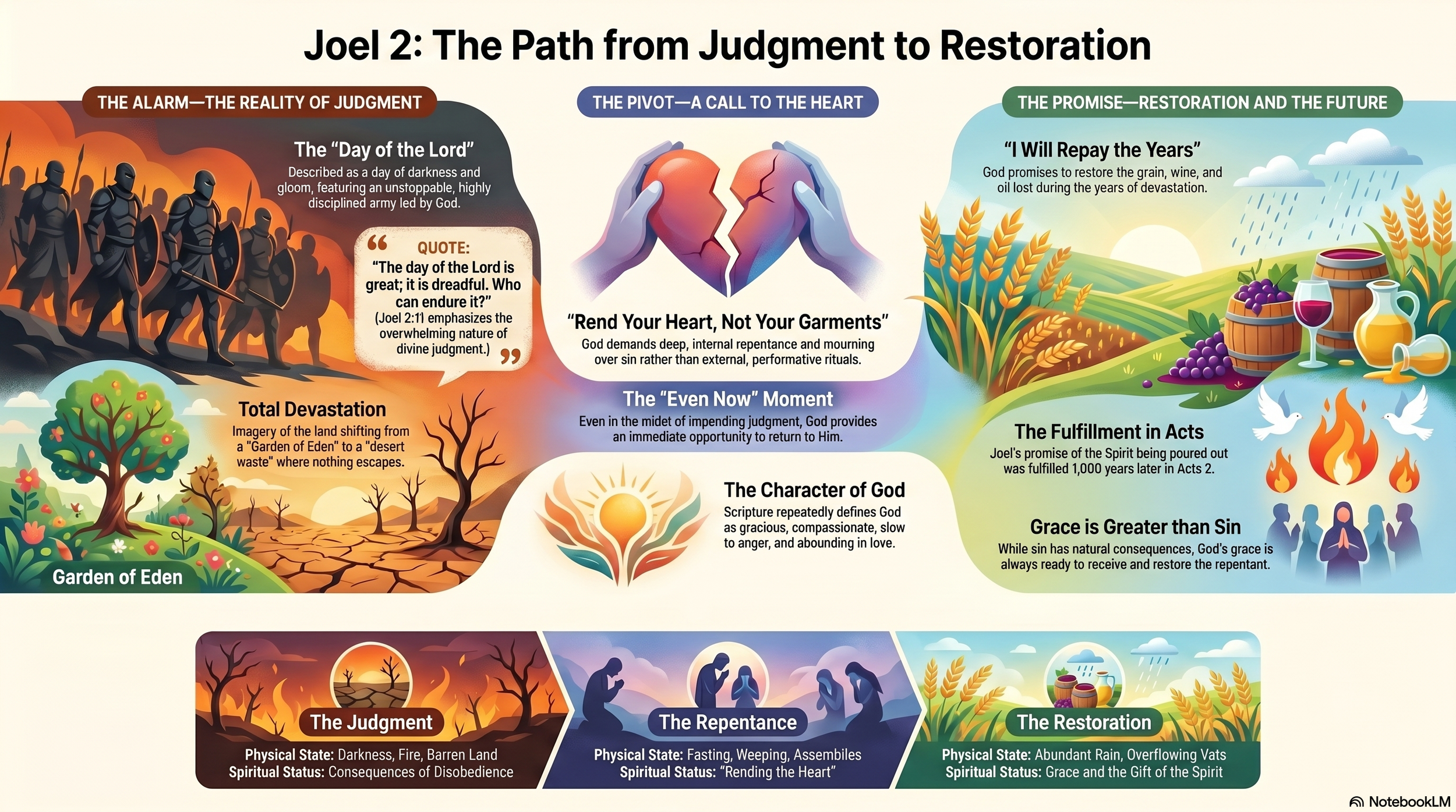
A Comprehensive Study of
Joel Chapter 2:
Judgment, Repentance, and Restoration
This study guide examines the second chapter of the book of Joel, analyzing the prophet's warning to the nation of Israel regarding the "Day of the Lord." The text explores the transition from a supernatural locust infestation to a description of a literal invading army, the divine call for internal repentance, and the ultimate promise of restoration and the outpouring of the Holy Spirit.
Review Quiz
1. What does the "Day of the Lord" represent within the context of Joel’s prophecy? The Day of the Lord is a multifaceted concept that refers to a specific day regarding the return of Christ, but in Joel’s immediate context, it serves as a picture of God's impending judgment. It is described as a "great and dreadful" time that involves both supernatural events and the arrival of a devastating invading force.
2. What is the significance of the command to "blow the trumpet in Zion"? Blowing the trumpet, likely a shofar or ram's horn, served as a modern-day equivalent of an air raid siren intended to sound an alarm and get the people's attention. It was a call for the nation to wake up, recognize the severity of the coming situation, and gather for a sacred assembly.
3. How does the text describe the invading army that God brings against Israel? The army is described with poetic and terrifying language as a "large and mighty" force that moves with total efficiency, marching in line without swerving or jostling. They have the appearance of horses and the noise of chariots, devouring the land like fire so that what was once like the Garden of Eden becomes a desert waste.
4. According to the text, who is leading the army that invades Israel, and why is this significant? The text identifies God as the one at the head of the army, thundering commands to the forces that obey Him. This is significant because it demonstrates that God can utilize foreign nation-states and even "terrible others" to carry out His divine purposes and bring judgment upon His own chosen people for their disobedience.
5. What is meant by the instruction to "rend your heart, not your garments"? Joel is calling for genuine, deep repentance rather than outward, performative displays of grief. While tearing one's clothes was a traditional sign of mourning, God desires that the people be truly heartbroken over their sin and behavior rather than just being sad about the impending consequences of judgment.
6. What attributes of God are highlighted as the basis for the people's return to Him? The text emphasizes that God is "gracious and compassionate, slow to anger and abounding in love." This specific phrasing appears repeatedly throughout the Old Testament—including in Exodus, Psalms, and Jonah—challenging the stereotype that the God of the Old Testament is exclusively a God of judgment.
7. In what way does the text address the "innocent" people living within a defiant community? The text suggests that because sin "leaks," individuals are often affected by the brokenness of the community to which they are connected. Even those who were faithful, like Nehemiah, participated in collective repentance because they recognized their connection to a broken people and understood that one can be harmed or blessed by the actions of others.
8. What physical restoration does God promise to the land after the period of judgment? God promises to repay the people for the years the locusts have eaten by sending abundant autumn and spring rains. This restoration includes the return of grain, new wine, and olive oil, ensuring that the threshing floors are full and the vats overflow, satisfying the people fully so they are no longer an object of scorn.
9. How does the New Testament book of Acts connect to the prophecy in Joel? Nearly a thousand years after Joel, the Apostle Peter quotes this chapter on the Day of Pentecost to explain the supernatural events occurring among the followers of Christ. Peter identifies the pouring out of the Holy Spirit on all people—sons, daughters, old men, and servants—as the direct fulfillment of Joel’s prophecy.
10. What is the relationship between sin and consequences for a follower of Christ according to the study? While the text asserts that followers of Christ are no longer under God's ultimate judgment because Jesus dealt with that on the cross, it warns that sin still carries natural consequences in the broken world. Engaging in sinful behavior often results in "reaping what they sowed," even if the believer remains under the umbrella of God's grace.
Answer Key
The Day of the Lord: A picture of God’s judgment and a future promise regarding the return of Christ.
The Trumpet: An alarm (shofar) meant to wake the people up and call them to a sacred assembly.
The Invading Army: A highly efficient, horse-like force that leaves total devastation (a desert waste) in its wake.
Leadership of the Army: God is at the head, showing He uses all types of nations to accomplish His purposes.
Rending the Heart: A call for internal, sincere repentance over outward, religious performance.
Attributes of God: Gracious, compassionate, slow to anger, and abounding in love (the concept of hesed).
Innocence in Community: Sin has a "trickle-out" effect, meaning the faithful often suffer and repent alongside the defiant.
Physical Restoration: The return of rain, grain, wine, and oil to replace what the "great army" of locusts destroyed.
Connection to Acts: Peter identifies the events of Pentecost (Acts 2) as the fulfillment of Joel’s promise regarding the Holy Spirit.
Sin and Consequences: Judgment is removed in Christ, but sin still has earthly consequences due to the way the universe is wired.
Essay Questions for Further Reflection
Analyze the use of nature imagery (locusts, fire, darkness, and gardens) in Joel 2. How do these images help convey the intensity of divine judgment and the beauty of restoration?
Compare and contrast the portrayal of God in the book of Joel with common modern perceptions of the "Old Testament God." Use specific textual evidence regarding His compassion and the concept of hesed.
The text states that "God utilizes nation states to carry out His purposes." Discuss the geopolitical implications of this statement and why the author suggests humans should be "slow to look at what's happening geopolitically" and claim to understand God's specific motives.
Examine the concept of collective repentance. Why does God demand that the elders, children, and even nursing infants be gathered together for the sacred assembly?
Discuss the role of Jesus Christ as the "fulfillment" of Joel’s prophecies. How does the New Covenant surpass the Old Covenant in its handling of judgment and the pouring out of the Spirit?
Glossary of Key Terms
Term
Definition
Day of the Lord
A biblical term referring to a time of God's direct intervention in human history for judgment or the fulfillment of His purposes.
Hesed
A Hebrew word used to describe God's covenantal love, often translated as "gracious," "compassionate," or "steadfast love."
New Covenant
The spiritual agreement established through Jesus Christ, which the text notes "far surpasses" the old covenant in grace and life.
Northern Horde
The invading army mentioned in Joel 2 that God promises to drive away into a parched and barren land as part of His deliverance.
Portico and Altar
The locations in the temple where the priests were commanded to weep and minister while pleading for God to spare His people.
Prophesy
To speak or declare a message under the influence of the Holy Spirit, promised to both men and women in the "last days."
Rend
To tear or split something; used metaphorically to describe the "tearing" of the heart in sincere repentance.
Shofar
A traditional Jewish instrument made from a ram's horn, used to sound alarms or signal celebrations.
Zion
Often referring to Jerusalem or the "holy hill," it represents the sacred location of God's presence and His chosen people.
