
Join Mercy Church as we kick off a new sermon series in the often-overlooked Book of Joel, exploring the powerful and sobering theme of the "Day of the Lord". Discover how Joel's warning of devastating locust swarms served as an urgent spiritual wake-up call to a nation that had fallen asleep. Most importantly, learn how to safely apply this Old Testament prophecy today by understanding that Jesus completely satisfied God's wrath on the cross. Watch now to awaken your soul to God's immense grace and embrace the freedom of the New Covenant, where followers of Christ experience love and discipline rather than fear and judgment.
Chapters
0:00 - Introduction to Joel & The Day of the Lord
2:50 - Jesus as Judge: Revelation's Portrayal
4:54 - Reflecting on God as Judge
6:27 - Joel's Urgent Call: The Locust Plague Begins
7:59 - The Catastrophic Scale of the Locusts
13:17 - A Call to Spiritual Awakening
17:10 - The Day of the Lord: Physical & Future Judgment
18:37 - Important Distinction: Israel vs. Modern Nations
21:00 - The New Covenant: Judgment Dealt with by Jesus
23:19 - No More Judgment: Only Love & Discipline
Deep Dive Podcast
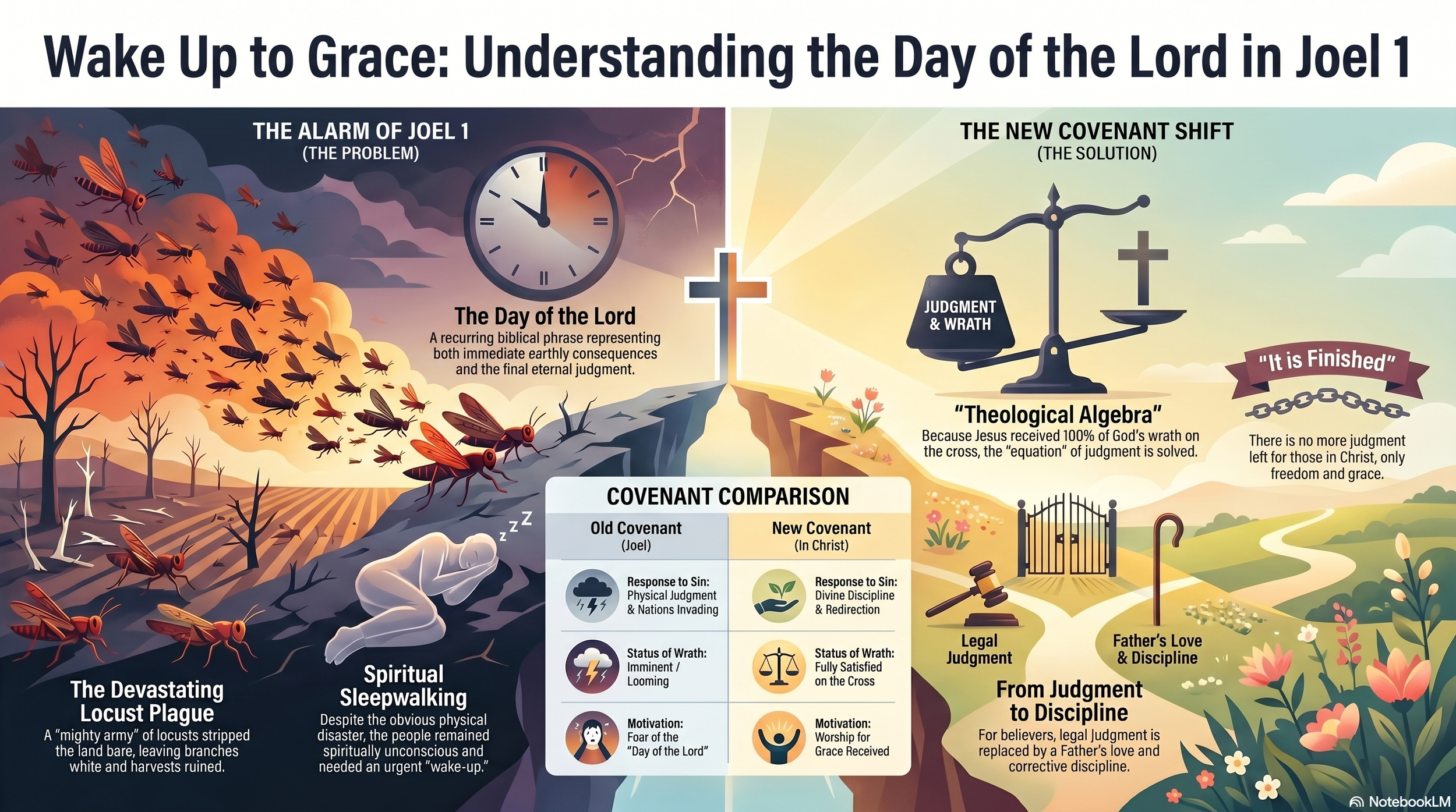
A Comprehensive Study of Joel Chapter 1: Judgment, Wakefulness, and Grace
This study guide examines the historical context, biblical imagery, and theological implications of the first chapter of the Book of Joel. It explores the themes of divine judgment, the necessity of spiritual alertness, and the fundamental shift in the experience of judgment for believers under the New Covenant.
Historical and Biblical Context
The Book of Joel is situated in the Old Testament among the Minor Prophets, positioned after the major prophets (Isaiah, Jeremiah, Ezekiel, and Daniel) and immediately following the Book of Hosea. It records the "Word of the Lord" that came to Joel, the son of Pethuel.
The primary audience of this letter was the nation of Israel, God’s chosen people. The text operates on multiple temporal levels, addressing the immediate circumstances of the Israelites, their future, and the ultimate future of all humanity.
The Day of the Lord
A central, recurring phrase in the book is "the Day of the Lord." While modern readers often associate this exclusively with the final judgment at the end of time, the biblical context suggests a broader meaning:
Immediate Judgment: Significant events in the present or near future that serve as a reckoning for disobedience.
Final Judgment: The ultimate, eternal accounting before God.
The document emphasizes that while God is rich in mercy and Jesus is Savior, they are also final judges. Revelation 19 provides a vivid description of Jesus as a judge, depicting him on a white horse, called "Faithful and True," judging with justice and treading the "winepress of the fury of the wrath of God Almighty."
The Locust Plague of Joel 1
Joel 1 describes a devastating locust infestation that serves as a physical wake-up call to the nation. This was not a standard agricultural nuisance; it was an unprecedented catastrophe designed to capture the people's attention across generations.
The Scale of Devastation
The text uses poetic and repetitive language to describe the total consumption of resources by different waves of locusts:
Agricultural Ruin: The locusts destroyed vines and fig trees, stripping the bark until the branches turned white. They wiped out grain, new wine, oil, pomegranates, date palms, and apple trees.
Animal Suffering: The lack of pasture caused cattle to moan and sheep to suffer. Wild animals "panted" for God as streams dried up.
Military Imagery: The locust swarm is described as a "mighty army without number" with the teeth and fangs of a lion.
The Call to Mourn and Wake Up
The devastation was so absolute that it necessitated a national response. Joel calls upon various groups to recognize the gravity of the situation:
The Drunkards: To weep because the "new wine" had been snatched from them.
The Farmers and Vine Growers: To despair because the harvest of the field was destroyed.
The Priests and Ministers: To put on sackcloth (uncomfortable, burlap-like clothing) and ash, fast, and call a "sacred assembly" to cry out to the Lord.
Theological Application: "Theological Algebra"
The study of Joel 1 requires what the text calls "theological algebra"—the process of correctly applying biblical truth to a modern context.
Misapplications to Avoid
National Identification: The United States of America is not the "New Israel." The specific promises and judgments directed at the "chosen people" in the Old Testament cannot be directly "plugged into" modern nations.
Inaccurate View of Wrath: For followers of Jesus, the threat of divine judgment for sin is fundamentally changed.
The New Covenant Shift
The most significant distinction for modern believers is living after the life, death, and resurrection of Jesus. Under the Old Covenant, the locusts were a precursor to a foreign nation being sent by God to judge Israel for disobedience (idolatry, sexual immorality, and injustice).
However, under the New Covenant:
Satisfied Wrath: The wrath of God was fully satisfied on the cross. Jesus received the punishment that believers deserved.
Love and Discipline: For those "in Christ," God no longer brings judgment. What remains is only love and discipline (redirection) rather than punitive wrath.
Spiritual Wakefulness: The call to "wake up" remains relevant. Just as Israel was "asleep" to the spiritual significance of the locusts, modern believers are urged to be "passionate rather than just present," particularly in communal worship.
--------------------------------------------------------------------------------
Quiz: Short-Answer Questions
Instructions: Answer the following questions in 2-3 sentences based on the provided text.
Where is the Book of Joel located in the Bible and to whom was it written?
What does the phrase "the Day of the Lord" signify in the Book of Joel?
How does the text describe the physical appearance of the trees after the locusts attacked?
According to the text, what is the role of Jesus as depicted in Revelation 19?
Why does Joel instruct the elders to tell the story of the locusts to their children and grandchildren?
What specific groups of people does Joel call to mourn, and why?
What are "sackcloth" and "ash" used for in the context of Joel 1?
Explain the concept of "theological algebra" mentioned in the sermon.
Why is it considered incorrect for a follower of Jesus to fear God’s judgment for their sins?
What is the stated purpose of Sunday morning worship services in the context of being "awake"?
--------------------------------------------------------------------------------
Answer Key
Location and Audience: The Book of Joel is found in the Old Testament, positioned after the major prophets and Hosea. It was written specifically to the nation of Israel, who were considered God’s chosen people.
Day of the Lord: This phrase refers to a time of judgment from God. In the context of Joel, it can mean an immediate judgment occurring in the present or near future, as well as the final, eternal judgment of all things.
Appearance of the Trees: The locusts were so destructive that they stripped the bark off the vines and fig trees. This left the branches completely white and the trees ruined.
Jesus in Revelation 19: Jesus is portrayed as a judge and a warrior riding a white horse, named "Faithful and True." He is described as the "Word of God" and the "King of Kings" who judges with justice and rules with an iron scepter.
Passing the Story: Joel emphasizes telling the story to multiple generations to ensure the truth is passed on for many years. This highlights the importance of the event and suggests that the people were currently uninformed or "asleep" to the truth.
Groups Called to Mourn: Joel calls on drunkards (due to the loss of wine), farmers (due to destroyed crops), and priests (because offerings to God had ceased). He wants everyone, from laborers to religious leaders, to recognize the severity of the spiritual and physical crisis.
Sackcloth and Ash: Sackcloth is a rough, uncomfortable material similar to burlap that was worn as a sign of deep pain and sorrow. Ashes were placed on the body to signify weeping, sadness, and a state of mourning before the Lord.
Theological Algebra: This is the process of reading a biblical text, seeing its original application, and then determining how it correctly relates to a modern life. It requires understanding the differences in covenants to avoid making mistakes in how one views God's current actions.
Fear of Judgment: For those in Christ, the wrath of God was fully satisfied on the cross when Jesus took the punishment for sin. Therefore, God no longer views the believer through the lens of judgment, but rather through love and discipline.
Purpose of Worship: Sunday worship serves as a call for believers to "wake up" spiritually and be truly present. It is intended to awaken the soul to God’s grace, goodness, and the reality of the gospel so that believers are passionate rather than just present.
--------------------------------------------------------------------------------
Essay Questions
The Duality of God: Analyze the text’s assertion that God is both a "richly merciful" Savior and a "Final Judge." How does the imagery of Revelation 19 support this, and why is this duality important for the believer's worldview?
Spiritual Somnambulism: Explore the metaphor of being "asleep" as applied to the nation of Israel and modern believers. What are the signs of spiritual sleepiness mentioned in the text, and what are the prescribed "awakenings"?
The Impact of the Locusts: Detail the total nature of the destruction described in Joel 1. How does Joel use agricultural devastation to signal a deeper spiritual reality, and why was this specific form of judgment so effective for his audience?
Covenantal Differences: Discuss the "theological algebra" required to move from the Old Testament's view of national judgment to the New Testament's view of grace. How does the "finished" work of Jesus on the cross change the interpretation of the Book of Joel for a modern Christian?
The Role of Community in Mourning: Examine the call for a "sacred assembly" and the involvement of the elders, priests, and the general populace. Why does Joel insist that the response to the "Day of the Lord" be a collective, public action rather than a private one?
--------------------------------------------------------------------------------
Glossary of Key Terms
Term
Definition
Day of the Lord
A biblical phrase denoting a period of divine intervention and judgment, either in an immediate historical context or the final end-times.
Joel
A prophet in the Old Testament; his name means "The Word of the Lord came to Joel son of Pethuel."
Locusts
Insects that travel in massive swarms; in Joel, they represent a "mighty army" that brings total agricultural and economic devastation as a form of judgment.
Minor Prophets
A collection of shorter prophetic books in the Old Testament, of which Joel is one.
New Covenant
The spiritual agreement established through the death and resurrection of Jesus, where God's wrath is satisfied and believers receive mercy and grace.
Pethuel
The father of the prophet Joel.
Sacred Assembly
A formal gathering of the community and its leaders for the purpose of fasting, prayer, and collective mourning before God.
Sackcloth
A coarse, dark fabric (often made of goat hair) worn as a symbol of mourning, penitence, or distress.
Theological Algebra
A metaphor for the systematic process of applying biblical principles to contemporary life while accounting for historical and covenantal differences.
Winepress of Fury
A metaphor from Revelation 19:15 describing the execution of God’s righteous judgment against sin.
