
I AM The Light Of The World
Join Nathan Mandsager as we start a series on Jesus saying "I AM..." . We start exploring Jesus' powerful claim in John 8:12: "I am the light of the world". Just as physical light is essential for life, Jesus provides the spiritual light we desperately need to survive and thrive. Through the biblical stories of the woman caught in adultery and the man born blind, we see how His light exposes our hidden brokenness to bring ultimate healing. Discover why bringing your burdens into the light of Jesus is truly the safest place you can ever be.
Chapters:
0:00 - Welcome and Opening Prayer
1:26 - Exploring Jesus' "I Am" Statements
4:09 - The Divine "I Am" - Connecting to Exodus
6:44 - Jesus Declares "I Am the Light of the World"
10:40 - Jesus as the Exclusive Source of Light
15:21 - Pharisees Question Jesus' Authority
20:29 - Jesus Exposes and Forgives Sin
24:58 - Jesus Heals the Man Born Blind
27:00 - Allowing Jesus to Guide Our Lives
30:20 - The Safest Place: Choosing Jesus
Study Guide: The "I AM" Series – Jesus as the Light of the World
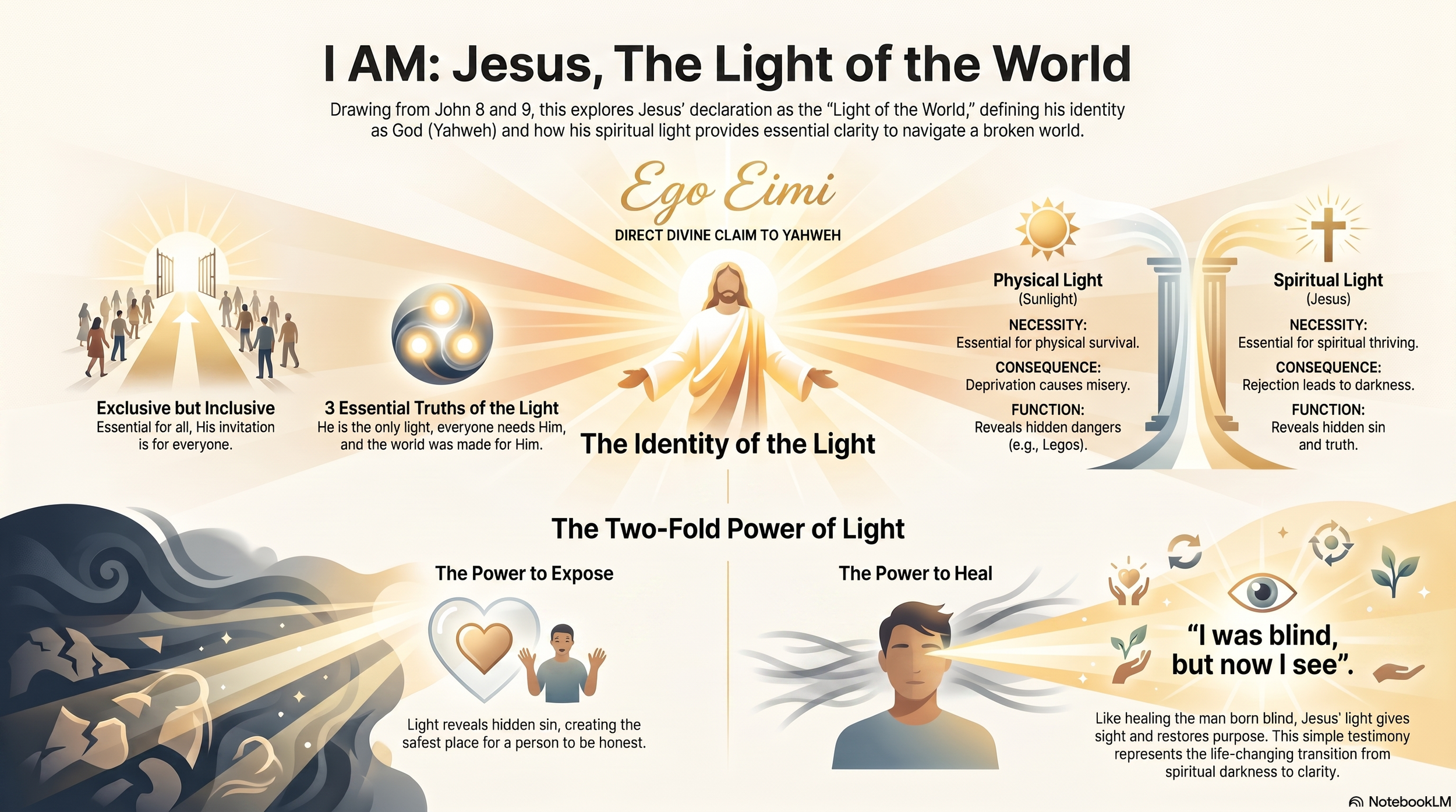
This study guide examines the identity and claims of Jesus through the lens of the Gospel of John, specifically focusing on the statement "I am the light of the world." It analyzes the linguistic roots of Jesus’ claims, the theological implications of his divinity, and the practical functions of light as a force that both exposes and heals.
Comprehensive Quiz
Questions
What is the linguistic significance of Jesus' "I Am" statements according to the original Greek text?
How does the speaker describe the "exclusively inclusive" nature of Jesus?
What are the three specific points regarding Jesus as light attributed to Dr. John Piper?
How does the text connect Jesus’ self-identification to the narrative of Moses in Exodus 3?
According to the "Torture Journal" cited in the text, what are the consequences of depriving a person of sunlight?
How does the speaker use the example of a "good steak" to differentiate between a believer’s and a non-believer’s perspective?
In the account of the woman caught in adultery, how did Jesus handle the accusers?
What was the prevailing cultural understanding of disability during the time of Jesus, as evidenced by the disciples' question regarding the man born blind?
What physical actions did Jesus take to heal the man born blind in John chapter nine?
How does the speaker define the process of "sanctification" for a follower of Jesus?
Answer Key
Linguistic Significance: In the original Greek, Jesus combines the words ego and emi, creating the phrase ego emi, which translates to "I am, I am." This specific word structure is a direct claim to identity and divinity, pointing back to the way God identified Himself in the Old Testament.
Exclusively Inclusive: Jesus is "exclusive" because he claims to be the only way, truth, and life, stating that no one comes to the Father except through him. However, he is "inclusive" because his invitation to follow him is extended to every breathing human being on the planet.
John Piper’s Points: First, Jesus is the only light in the world, and everything else is darkness. Second, everyone in the world needs Jesus as their light to have life. Third, the world was created specifically for this light to fill it.
Connection to Exodus: In Exodus 3, God speaks to Moses from a burning bush and identifies Himself as "I am who I am," which the Jews identified as Yahweh. Jesus uses the same language of "I am" to identify himself as the same God who is over all creation and beyond space and time.
Deprivation of Sunlight: The journal states that sunshine is synonymous with happiness and life, and without it, humans wither and die. Depriving a person of light has severe physical and psychological consequences and is used in torturous environments to induce misery and suffering.
The Steak Illustration: For a non-believer, a good steak is simply a good meal. For a believer, the experience is elevated to worship because they recognize the ultimate source of the meal is the hand of God who created the world.
The Accusers: Jesus did not initially address the woman; instead, he wrote in the ground, confronting the accusers. Starting from the oldest to the youngest, the accusers dropped their stones and walked away until only Jesus and the woman remained.
Understanding of Disability: It was commonly understood that if a person had a disability, it was likely tied to sin within the family. This is shown when the disciples ask Jesus whether the man’s blindness was caused by his own sin or the sin of his parents.
Healing the Blind Man: Jesus spat on the ground and used his saliva to make mud. He then anointed the man’s eyes with the mud and instructed him to wash in the Pool of Siloam.
Sanctification: The speaker defines sanctification as the ongoing process of God making a believer more like Himself over time. This involves God "chipping away" at sin and error in a person's heart and mind throughout their life.
Essay Format Questions
The Dual Function of Light: Analyze how the text presents the light of Jesus as both an exposing and a healing force. Use the accounts of the woman caught in adultery and the man born blind to support your argument.
Divinity vs. Moral Teaching: Explore the conflict between the modern view of Jesus as a "good moral teacher" and his own claims in the Gospel of John. Why does the speaker argue that Jesus’ "I Am" statements make it impossible to view him merely as a gentle rabbi?
The Theology of "I AM": Explain the significance of the term ego emi and its connection to the Old Testament name Yahweh. How does this linguistic link serve as the foundation for Jesus' authority over "all cultures of all time"?
The Danger of "Lesser Lights": Discuss the speaker's warning regarding the tendency of people to settle for "lesser lights." How does the text describe the risks of compartmentalizing faith to a Sunday morning versus a daily surrender?
Spiritual vs. Physical Blindness: Compare the physical disorientation of the speaker’s brother-in-law with the concept of spiritual blindness described in the text. How does the light of Jesus provide "sight-giving" clarity to the injustices and brokenness of the world?
Glossary of Key Terms
Term
Definition
Ego Emi
The Greek phrase for "I am, I am," used by Jesus to denote his divine identity.
Exclusively Inclusive
The theological concept that Jesus is the sole path to God (exclusive) but offers an open invitation to all humanity (inclusive).
Incarnate
The act of God taking on human form and entering the world as Jesus.
Manifest
A term meaning the light was "turned on" or made clearly visible, as if a light switch was flipped.
Pharisees
A group of Jewish leaders who challenged Jesus' testimony and viewed his claims of divinity as offensive and worthy of arrest or death.
Retinitis Pigmentosa
A degenerative genetic eye disease mentioned as the cause of the speaker's brother-in-law's blindness.
Sanctification
The lifelong process by which a follower of Jesus is progressively changed to become more like God.
Siloam
A pool in Jerusalem where the blind man was sent to wash; the name literally means "sent."
Yahweh
The Hebrew name for God revealed to Moses, translated as "I am who I am."
