
I AM The Bread of Life
Deep Dive
Chapters:
0:00 - Introduction to the 'I Am' Series: Bread
0:54 - Bread as Sustenance and Symbol
3:27 - The Feeding of the 5,000
6:05 - Miracles and Pursuit: Walking on Water
8:47 - Seeking the Hand, Not the Face
13:10 - Demanding More Signs
17:05 - Jesus: 'I Am the Bread of Life'
19:11 - False Sustenance and Spiritual Hunger
22:38 - The Need for Eternal Sustenance
25:01 - Time with Jesus and Sharing the Bread
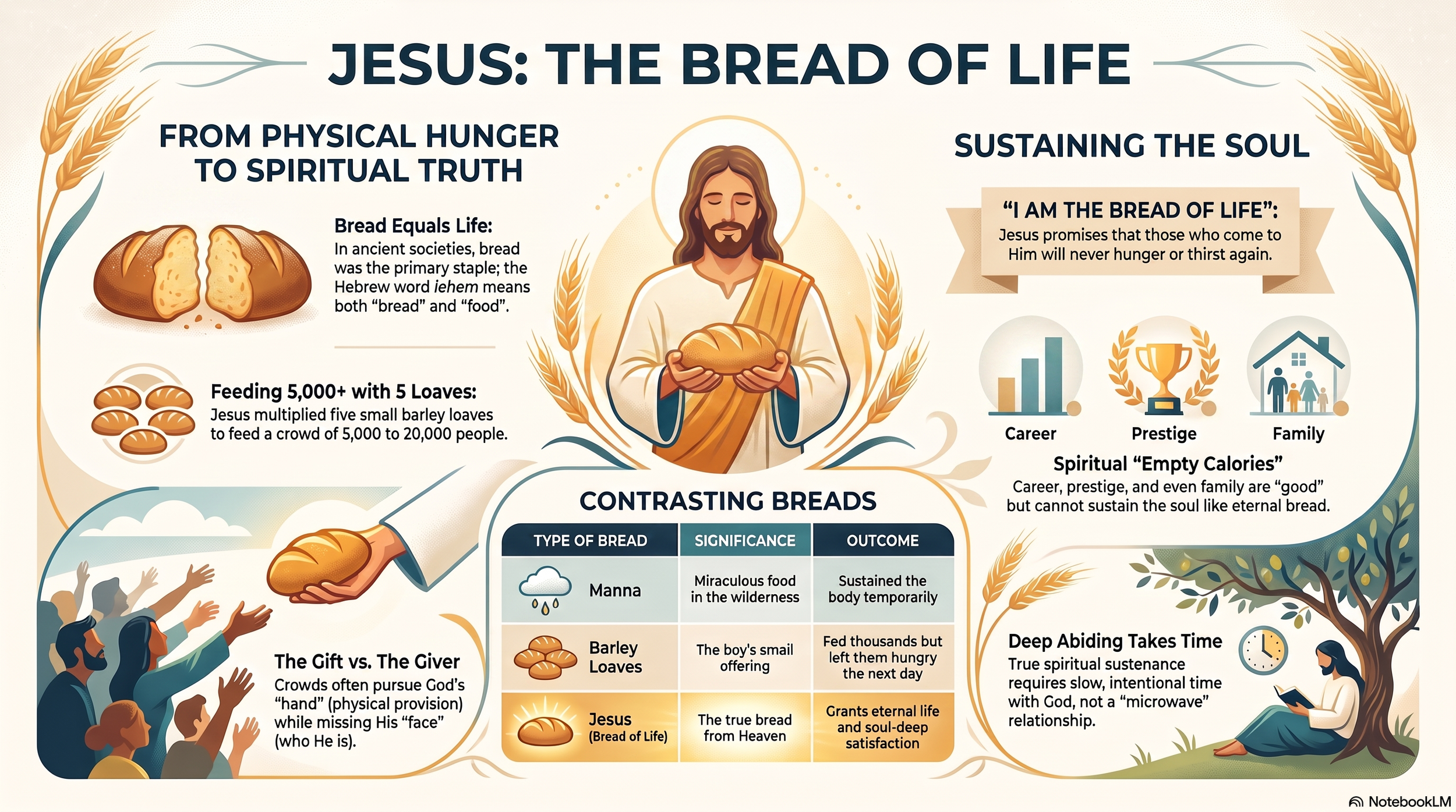
Study Guide: Jesus as the Bread of Life (John 6 Analysis)
This study guide explores the theological and cultural significance of Jesus' declaration, "I am the bread of life." It examines the historical context of bread in ancient Israel, the miraculous feeding of the 5,000, and the spiritual distinction between physical sustenance and eternal life as presented in the Gospel of John.
Short-Answer Quiz
Instructions: Answer the following questions in two to three sentences based on the provided text.
What is the linguistic significance of the Hebrew word lehem in ancient Israelite society?
Why is matzah referred to as the "bread of affliction," and what does its form represent?
According to the text, what is the estimated total number of people at the "feeding of the 5,000," and why?
How does the text refute the "generosity theory" regarding the miracle of the loaves and fish?
What was the crowd’s immediate reaction after witnessing the miraculous multiplication of food?
What does Jesus identify as the "work of God" when questioned by the crowd?
How does the text define the difference between seeking the "hand of God" and the "face of God"?
What historical event does the crowd reference when asking Jesus for a sign, and how does Jesus correct their understanding?
Using the analogy of "breadcrumbs" or "rotten croutons," what point does the text make about spiritual health?
What lesson about spiritual relationship is drawn from the Argentinian custom of shared meals?
Quiz Answer Key
The linguistic significance of lehem: In ancient Israelite society, bread was so fundamental to survival that the word lehem became synonymous with the general term for food or chow. Because protein options like steak or chicken were reserved for the wealthy or special festivals, bread served as the primary source of daily sustenance.
Matzah as the "bread of affliction": Matzah is a flat, unleavened bread that symbolizes the period when the nation of Israel was being oppressed and had to flee in haste. Its flat form represents the fact that the people did not have enough time to let the dough rise before they were forced to leave.
Estimated total at the feeding: While the biblical text specifies there were 5,000 men present, the actual crowd size was likely between 5,000 and 20,000 people. This higher estimate accounts for the women and children who accompanied the men to hear Jesus.
Refutation of the "generosity theory": The text argues that the feeding was a literal divine miracle rather than a mere display of human sharing prompted by the boy's generosity. This is evidenced by the fact that the witnesses recognized it as a supernatural event and subsequently tried to make Jesus king by force.
The crowd's reaction: After seeing the miracle, the crowd was so amazed by Jesus’ supernatural power that they attempted to take him by force to make him their king. Jesus, however, had no interest in this political role and withdrew from the location.
The "work of God": Jesus clarifies that the work required by God is not a checklist of deeds or following a specific scroll of rules. Instead, the "work" is simply to believe and place one's trust in the one whom God has sent.
The "hand" vs. the "face" of God: Seeking the "hand of God" refers to focusing on the gifts and provisions God provides, such as literal food or miracles. Seeking the "face of God" means focusing on a relationship with the Giver himself rather than being distracted by the material benefits he offers.
Historical reference and correction: The crowd references the manna provided in the wilderness during the Exodus, attributing it to Moses. Jesus corrects them by stating that it was his Father, not Moses, who gave them bread from heaven, and that He now offers the "true bread" that gives life to the world.
Breadcrumbs and spiritual health: The text uses these terms to describe how people often try to sustain their spirits with "old breadcrumbs" or "rotten croutons"—things like jobs, power, or even family—that cannot truly satisfy. This leads to a state of spiritual starvation because these items lack the eternal nutrients found only in the "bread of life."
Argentinian meal custom: The Argentinian tradition of spending all day preparing and eating a meal highlights that deep connection takes significant time. Similarly, the text suggests that an "abiding relationship" with Jesus cannot be "microwaved" or rushed; it requires slowing down to be sustained by Him.
Essay Questions
Literal vs. Symbolic Sustenance: Analyze how Jesus uses the literal situation of the feeding of the 5,000 to transition into a deeper spiritual teaching. How does the text use historical and cultural examples of bread to support this transition?
The Nature of Belief and Miracles: The text mentions an "equation" of "one more plus one" regarding miracles. Discuss the relationship between witnessing supernatural signs and the development of authentic faith as described in the John 6 narrative.
Spiritual Diet and Modern Distractions: Using the analogies of the comedian Nate Burgatzi and the ordination "mini quiches," examine the text's argument regarding how individuals become distracted by the "goodness of God" and miss the "moment of God."
The Role of the Father in Jesus' Ministry: Explore the text's depiction of the Father's will and His role in providing "true bread." How does Jesus describe his relationship to the Father in terms of his mission and the security of those "given" to him?
The Responsibility of the "Fed": The conclusion of the text suggests that spiritual bread is not meant to be kept in a "backpack." Discuss the implications of the "bread of life" teaching for communal life and the individual believer's responsibility to others.
Glossary of Key Terms
Term
Definition
Bread of Affliction
A symbolic name for matzah, representing the haste and oppression of the Israelites during their exodus from Egypt.
Bread of Life
A title Jesus applies to himself, indicating that he is the source of spiritual sustenance that satisfies eternal hunger and thirst.
Feeding of the 5,000
A miracle where Jesus multiplied five barley loaves and two small fish to feed a large crowd, leaving leftovers and demonstrating divine provision.
I Am Statements
A series of declarations made by Jesus in the New Testament to define his identity and nature through various metaphors.
Lehem
The Hebrew word for bread, which in ancient contexts was often used as a general synonym for food or sustenance.
Manna
Miraculous "bread from heaven" provided by God to the Israelites during their time in the wilderness.
Matzah
Flat, unleavened bread made without yeast because there was no time for the dough to rise during the Israelites' escape from oppression.
Satiated
The state of being completely satisfied or full, used in the text to describe the effect of "consuming" the spiritual bread Jesus offers.
Son of Man
A title used for Jesus in the text, associated with the one upon whom God the Father has placed his "seal of approval."
Sustenance
Means of maintaining life or nourishment; the text distinguishes between physical sustenance (which spoils) and spiritual sustenance (which endures).
