
Jesus Prays
As Mercy Church enters the season of Lent, join Pastor Tim for a powerful message exploring the Passion of the Christ. This week's sermon dives into Matthew 26, examining Jesus's agonizing moments of prayer in the Garden of Gethsemane just before His arrest and crucifixion. Discover how Christ's response to overwhelming sorrow teaches us to bring our deepest pain to God with both clear, honest requests and total submission. Ultimately, this passage reminds us of the profound love of a Savior who willingly stepped toward the cross for our redemption.
Deep Dive Podcast
Study Guide: The Passion of Christ in the Garden of Gethsemane
This study guide provides an in-depth review of the biblical account of Jesus in the Garden of Gethsemane as recorded in Matthew 26. It explores the themes of suffering, prayer, the integration of the physical and spiritual, and the ultimate resolve of Christ leading toward his crucifixion.
--------------------------------------------------------------------------------
Part I: Short-Answer Quiz
Instructions: Answer the following questions based on the provided text. Each response should be approximately 2-3 sentences.
What is the linguistic origin and meaning of the word "passion" in the context of the "Passion of the Christ"?
What is the literal meaning of the word "Gethsemane," and how does this serve as a symbol for Jesus’ experience there?
According to the text, why is "presence" the most important response to the problem of pain and suffering?
Who were the three disciples Jesus invited deeper into the "sacred space" of his suffering, and what does this suggest about human relationships?
How does the description of the Kidron Brook during Passover provide a vivid backdrop for Jesus’ prayer in the garden?
In what way does the text describe humans as "integrated beings" regarding Jesus' physical and emotional state?
What is the "Cup of Wrath" mentioned in Jesus' prayer, and what does it represent in an Old Testament context?
What "middle space" in prayer does Jesus model for his followers between making requests and submitting to God?
How does Jesus use the disciples' failure to stay awake as a lesson regarding the "spirit" and the "flesh"?
What is significant about the specific Greek verb Jesus uses when he says "Rise! Let us go!" at the end of the passage?
--------------------------------------------------------------------------------
Part II: Answer Key
What is the linguistic origin and meaning of the word "passion" in the context of the "Passion of the Christ"? The word "passion" comes from a Latin root that connects specifically to the suffering of Christ. In the church calendar, it refers to the season leading up to Easter, culminating in his arrest, crucifixion, and resurrection.
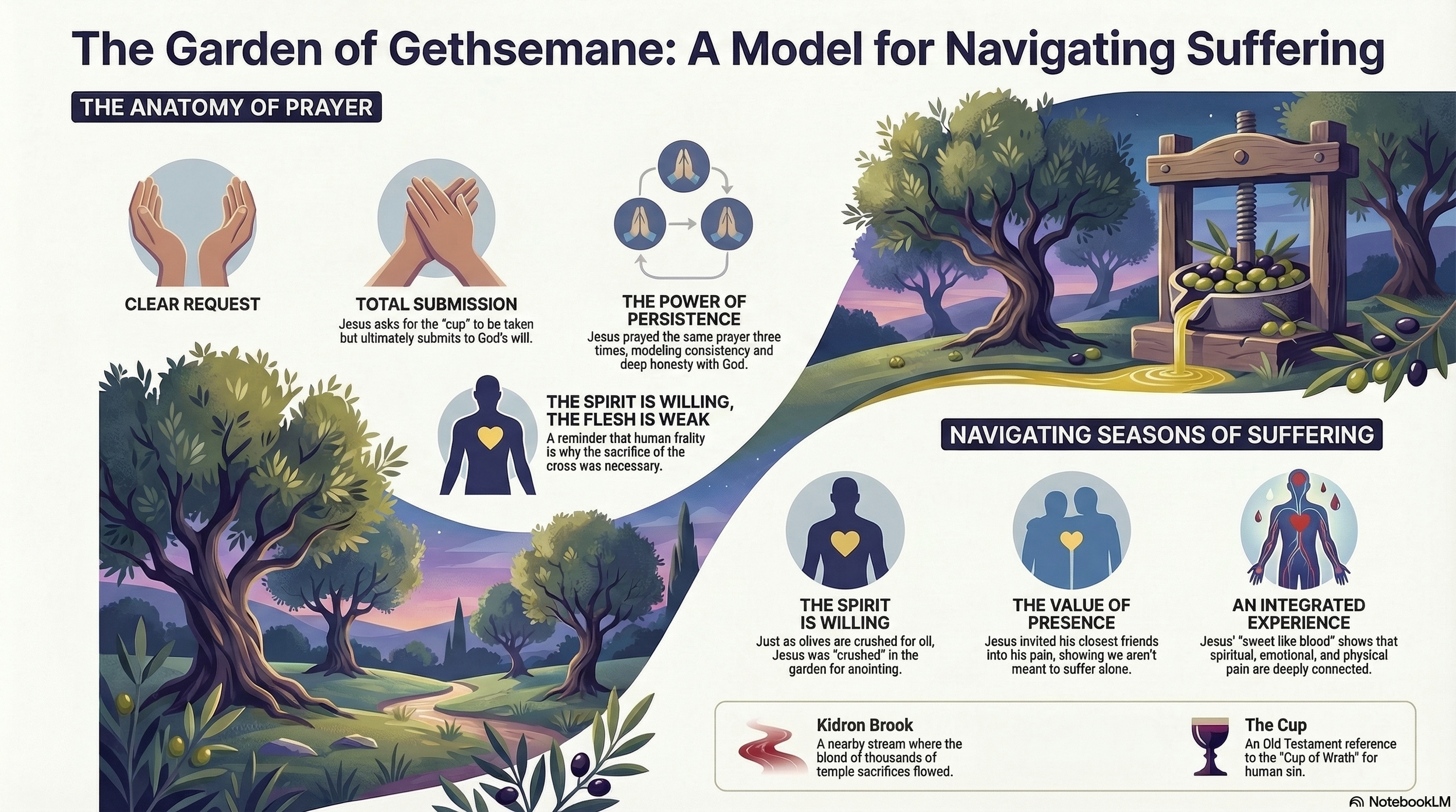
What is the literal meaning of the word "Gethsemane," and how does this serve as a symbol for Jesus’ experience there? Gethsemane means "olive press," a place where olives from the grove were crushed to produce oil. This is symbolic of Jesus, the one who would soon be crushed on the cross, entering a place of "crushing" prayer to be anointed for what lay ahead.
According to the text, why is "presence" the most important response to the problem of pain and suffering? The text suggests that when people are in pain, they naturally desire to be with those who love and care for them. While humans may not have all the answers to why suffering occurs, the simple act of walking with someone and offering support is a sacred responsibility and calling.
Who were the three disciples Jesus invited deeper into the "sacred space" of his suffering, and what does this suggest about human relationships? Jesus took Peter and the two sons of Zebedee (James and John) further into the garden to keep watch with him. This demonstrates that while it is right to love many people, it is also natural and acceptable to have a smaller, closer knit group allowed into one's most private and painful moments.
How does the description of the Kidron Brook during Passover provide a vivid backdrop for Jesus’ prayer in the garden? During Passover, the historian Josephus noted that approximately 250,000 animals were sacrificed, with blood flowing out of the temple and into the Kidron Brook. As Jesus prayed in the garden, he was physically near a stream of blood from these sacrifices, foreshadowing his own role as the perfect sacrifice.
In what way does the text describe humans as "integrated beings" regarding Jesus' physical and emotional state? Jesus is described as an integrated being whose spiritual anguish manifested physically, such as when he experienced "violent emotions" and sweated drops of blood. This shows that suffering is not just a spiritual or emotional experience, but one that involves the body and the soul interacting simultaneously.
What is the "Cup of Wrath" mentioned in Jesus' prayer, and what does it represent in an Old Testament context? The "cup" is an Old Testament reference to God’s wrath being poured out in response to human evil and darkness. Jesus prayed that this cup might be taken from him, as he was preparing to have that wrath poured onto him instead of onto humanity.
What "middle space" in prayer does Jesus model for his followers between making requests and submitting to God? Rather than just listing requests or passively accepting fate, Jesus models a prayer of "clear request and total submission" at the same time. He honestly expresses his desire for the suffering to pass while remaining completely willing to submit to the Father's ultimate will.
How does Jesus use the disciples' failure to stay awake as a lesson regarding the "spirit" and the "flesh"? Jesus observes that "the spirit is willing, but the flesh is weak," acknowledging that while people may desire to do what is right, earthly temptations and physical limitations often pull them away. Their inability to keep watch served as a reminder of the human frailty that necessitated his journey to the cross.
What is significant about the specific Greek verb Jesus uses when he says "Rise! Let us go!" at the end of the passage? The verb used for "rise" does not merely mean to wake up, but rather to "stand up" because it is time to move. It signifies that Jesus had moved past his moment of internal struggle and was now setting his face toward the cross with clarity and resolve.
--------------------------------------------------------------------------------
Part III: Essay Questions
Instructions: Use the themes and data points from the text to develop comprehensive responses to the following prompts.
The Symbolism of the Grove: Analyze the various meanings associated with the Garden of Gethsemane in the text, including the olive press, the act of anointing, and the presence of the Kidron Brook. How do these physical elements reinforce the theological message of the Passion?
The Theology of Prayer: Explore Jesus’ model of prayer as described in the transcript. Discuss the importance of honesty, persistence, and the tension between personal desire and divine submission.
Divine Necessity and Human Failure: Explain the text’s argument for why Jesus "had" to go to the cross. In your answer, contrast the "weakness of the flesh" exhibited by the disciples with the "perfect sacrifice" required for justice and mercy.
Suffering as an Integrated Experience: Discuss the concept that humans are "integrated beings." How does the text use Jesus’ physical and emotional reactions in Gethsemane to provide a model for how believers should view their own experiences of pain?
The Turning Point of Resolve: Trace the emotional arc of Jesus from being "overwhelmed with sorrow to the point of death" to his final command to "Rise! Let us go!" What does this transition suggest about the relationship between prayer and spiritual clarity?
--------------------------------------------------------------------------------
Part IV: Glossary of Key Terms
Term
Definition
Anointing
The sacred act of putting oil on a person (often a king or leader) as an affirmation of their identity or a conferring of a sacred status.
Cup of Wrath
An Old Testament metaphor for God's judgment against evil; in the New Testament, it represents the suffering Jesus accepted on behalf of humanity.
Flesh, The
The earthly, natural desires and physical limitations of human beings that often conflict with spiritual intentions.
Gethsemane
A grove of olive trees where Jesus prayed before his arrest; the name literally translates to "olive press."
Integrated Beings
The concept that humans are not just physical or spiritual, but a unified whole where emotions, body, and spirit interact.
Josephus
A well-known historian from the time of Jesus who documented details about temple sacrifices and Passover.
Kidron Brook
A stream near the Garden of Gethsemane where the blood from temple sacrifices flowed during the Passover season.
Lent
A season in the church calendar leading up to Easter, characterized by a focus on the suffering (Passion) of Christ.
Passion
Derived from a Latin word for suffering; it refers to the final period of Jesus’ life, including his agony in the garden and his crucifixion.
Sons of Zebedee
Refers to James and John, two of the three disciples (along with Peter) who formed Jesus' closest inner circle.
