
Jesus Arrested
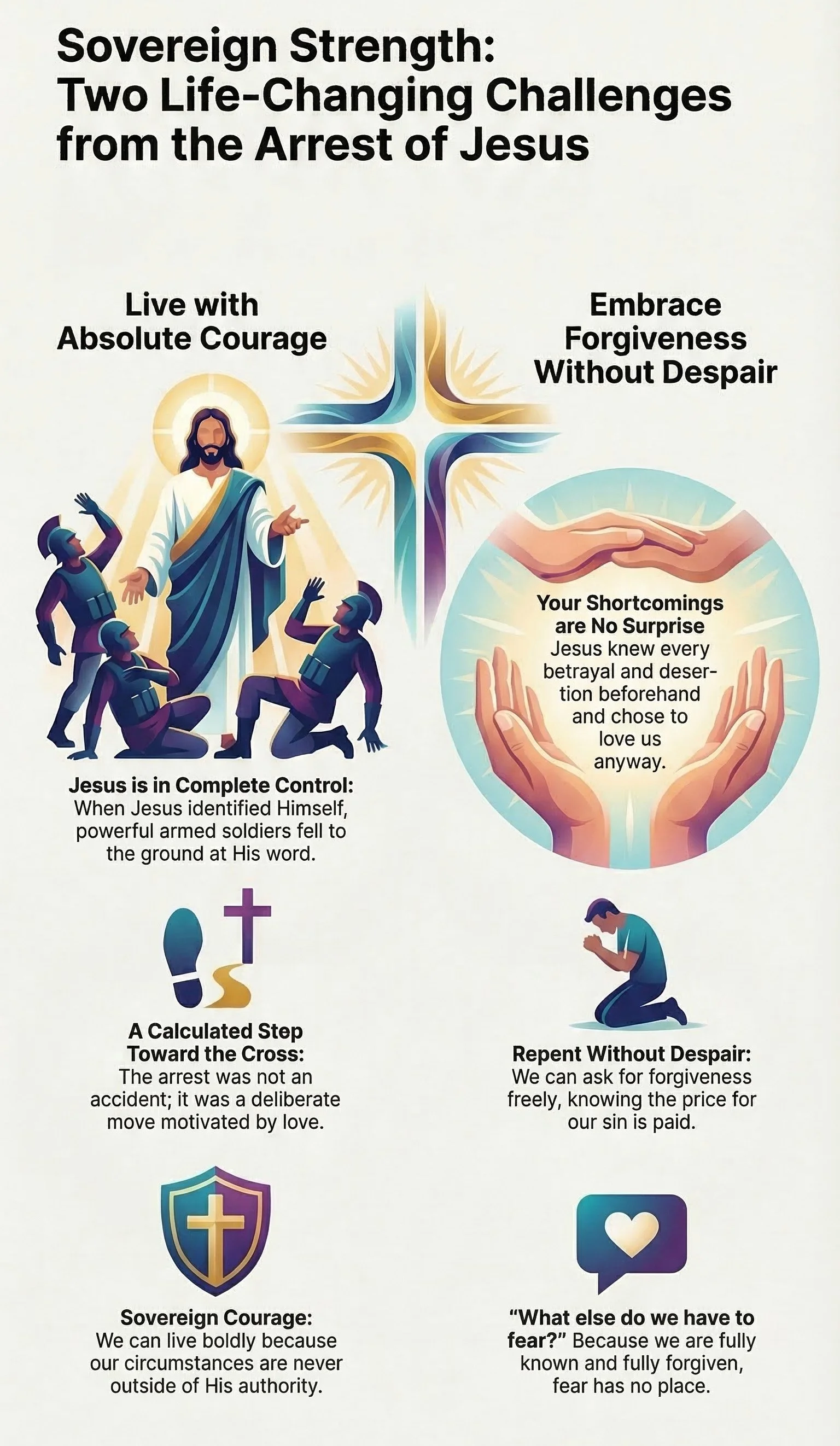
In this sermon, Mike Nagel explores the powerful story of Jesus's arrest in the Garden of Gethsemane, revealing how Christ was completely intentional and in control of His journey to the cross. Even though He knew He would be betrayed by Judas and abandoned by His closest friends, Jesus willingly sacrificed Himself out of profound love for us. This ultimate act of grace challenges us to live with absolute courage regardless of our circumstances and to confidently seek His forgiveness without despair when we fall short. Watch as we discover how to live differently in light of Christ's perfect love and supreme power over all creation.
Deep Dive Podcast
Study Guide: The Arrest and Intentional Sacrifice of Jesus
This study guide examines the narrative of Jesus’s arrest as recorded in John 18 and interpreted in the sermon by Mike Nagel. The material focuses on the intentionality of Jesus, the nature of betrayal, and the theological implications of his sacrifice for contemporary life.
--------------------------------------------------------------------------------
Part 1: Short-Answer Quiz
Instructions: Answer the following ten questions in 2–3 sentences, based on the provided text.
Where did Jesus and his disciples go after the Last Supper, and who knew to find them there?
How did the Roman soldiers and temple guards react when Jesus identified himself by saying, "I am he"?
In what ways did Jesus demonstrate intentionality in the week leading up to his arrest?
According to the sermon, what was the significance of the "I am" statement Jesus used in the garden?
What was the "power reversal" involved in the way Judas chose to identify Jesus to the guards?
What is the symbolic or historical significance of the "30 pieces of silver" paid to Judas?
How did Peter react during the arrest, and how did Jesus respond to Peter’s actions?
Who is the "young man" mentioned in the Gospel of Mark, and why do scholars think his inclusion is significant?
What does the sermon suggest is the difference between "adding Jesus to your life" and "giving your life to Jesus"?
How does the knowledge that Jesus is in complete control affect how a believer should face personal trials like health issues?
--------------------------------------------------------------------------------
Part 2: Answer Key
Where did Jesus and his disciples go after the Last Supper, and who knew to find them there? Jesus led his disciples across the Kidron Valley into a grove of olive trees, often referred to as the Garden of Gethsemane. Judas, the betrayer, knew this location well because Jesus frequently met there with his disciples.
How did the Roman soldiers and temple guards react when Jesus identified himself by saying, "I am he"? When Jesus spoke those words, the armed soldiers and guards were blown backward and fell to the ground. This reaction demonstrated that even in his arrest, Jesus possessed a power that he was voluntarily holding back.
In what ways did Jesus demonstrate intentionality in the week leading up to his arrest? Jesus intentionally set events in motion by riding into Jerusalem on a donkey to fulfill prophecy and by "picking a fight" with leaders in the temple. He further directed the timeline by telling Judas during the Last Supper to go and do what he needed to do.
According to the sermon, what was the significance of the "I am" statement Jesus used in the garden? The phrase is a direct reference to Exodus 3, where God identifies Himself to Moses as "I AM WHO I AM." By using this name, Jesus was identifying himself as God in the flesh and the creator of all things.
What was the "power reversal" involved in the way Judas chose to identify Jesus to the guards? According to the customs of the day, the more important person typically extended a kiss to welcome another. By initiating a deep, intimate embrace and kiss, Judas attempted a power reversal over his teacher, whom he called "Rabbi."
What is the symbolic or historical significance of the "30 pieces of silver" paid to Judas? Thirty pieces of silver was not a massive sum of money; rather, it was the standard price paid at that time for a slave who had been accidentally killed by an ox. This suggests that the religious leaders viewed Jesus’s life as having the same value as a common slave.
How did Peter react during the arrest, and how did Jesus respond to Peter’s actions? Peter drew a sword and cut off the right ear of Malchus, the high priest’s slave. Jesus rebuked Peter, telling him to put his sword away and asking if he should not "drink from the cup of suffering" given to him by the Father.
Who is the "young man" mentioned in the Gospel of Mark, and why do scholars think his inclusion is significant? The text mentions a young man who fled the scene naked after his linen shirt was grabbed; many believe this was Mark, the author of the Gospel, inserting himself into the story. The mention of a "linen" garment suggests the individual may have been wealthy.
What does the sermon suggest is the difference between "adding Jesus to your life" and "giving your life to Jesus"? Adding Jesus is described as treating faith like a hobby or an accessory to one’s existing life. In contrast, giving one's life to Jesus means making him the absolute priority, where he is first and everything else is a "distant second."
How does the knowledge that Jesus is in complete control affect how a believer should face personal trials like health issues? Because Jesus is in control of everything and orchestrated his own sacrifice out of love, believers can find "absolute courage." This allows them to live boldly and find peace in the fact that their circumstances—such as a health crisis—are never outside of His control.
--------------------------------------------------------------------------------
Part 3: Essay Questions
Instructions: Use the provided source context to develop comprehensive responses to the following prompts.
The Sovereignty of Jesus in Captivity: Analyze the evidence provided in the text to support the claim that Jesus was not a victim of circumstance, but rather the orchestrator of his own arrest and crucifixion.
The Nature of Betrayal: Compare and contrast the betrayal of Judas with the desertion of the other disciples. How does the sermon categorize these different types of shortcomings in a modern context?
Biblical Parallelism: Explore the connection the speaker makes between the scene in the olive grove and the "I AM" revelation in Exodus. How does this connection reshape the reader's understanding of the power dynamics during the arrest?
Misunderstanding the Messiah: Discuss the speculation regarding Judas’s motivations. How did the desire for an "earthly king" lead to a fundamental misunderstanding of Jesus’s mission?
Application of Grace: Explain the sermon’s argument that Jesus’s prior knowledge of human failure allows for "forgiveness without despair." How does this concept change the way a person might approach their own moral or spiritual shortcomings?
--------------------------------------------------------------------------------
Part 4: Glossary of Key Terms
Term
Definition
30 Pieces of Silver
The price paid to Judas for betraying Jesus; historically the value assigned to a slave killed by an ox.
ALS
Amyotrophic Lateral Sclerosis; a fast-moving, aggressive disease mentioned in the sermon's anecdote regarding Sue Boardman.
Exodus 3
The Old Testament passage where God speaks to Moses from a burning bush and reveals His name as "I AM."
Gethsemane
The olive grove/garden where Jesus was arrested; a place he frequently visited with his disciples.
Intentionality
The quality of Jesus's actions as described by Nagel; the idea that Jesus was purposefully moving toward the cross.
I Am He
The specific phrase Jesus used to identify himself to the guards, signaling his divine authority and causing them to fall.
Judas
One of the twelve disciples; the "CFO" of the group who eventually betrayed Jesus to the authorities.
Kidron Valley
The valley Jesus crossed to reach the olive grove where his arrest took place.
Malchus
The slave of the high priest whose ear was cut off by Peter during the struggle in the garden.
Rabbi
A term of honor meaning "Teacher," used by Judas when he greeted Jesus in the garden.
