
Daniel 6 (part 2) - Daniel and the dawn of Christ
‘In the final week of our series on the Book of Daniel”, Nathan explores the famous story of the lion's den to show how Daniel's unwavering faith points directly to the ultimate rescue mission of Jesus Christ. Learn why “true obedience is born out of a deep relationship with God” rather than mere compliance to rules, and why we must trust Him in our darkest trials whether He physically delivers us or not. Join Mercy Church as we discover what it means to “stop chasing miracles and start passionately pursuing the God of miracles”.
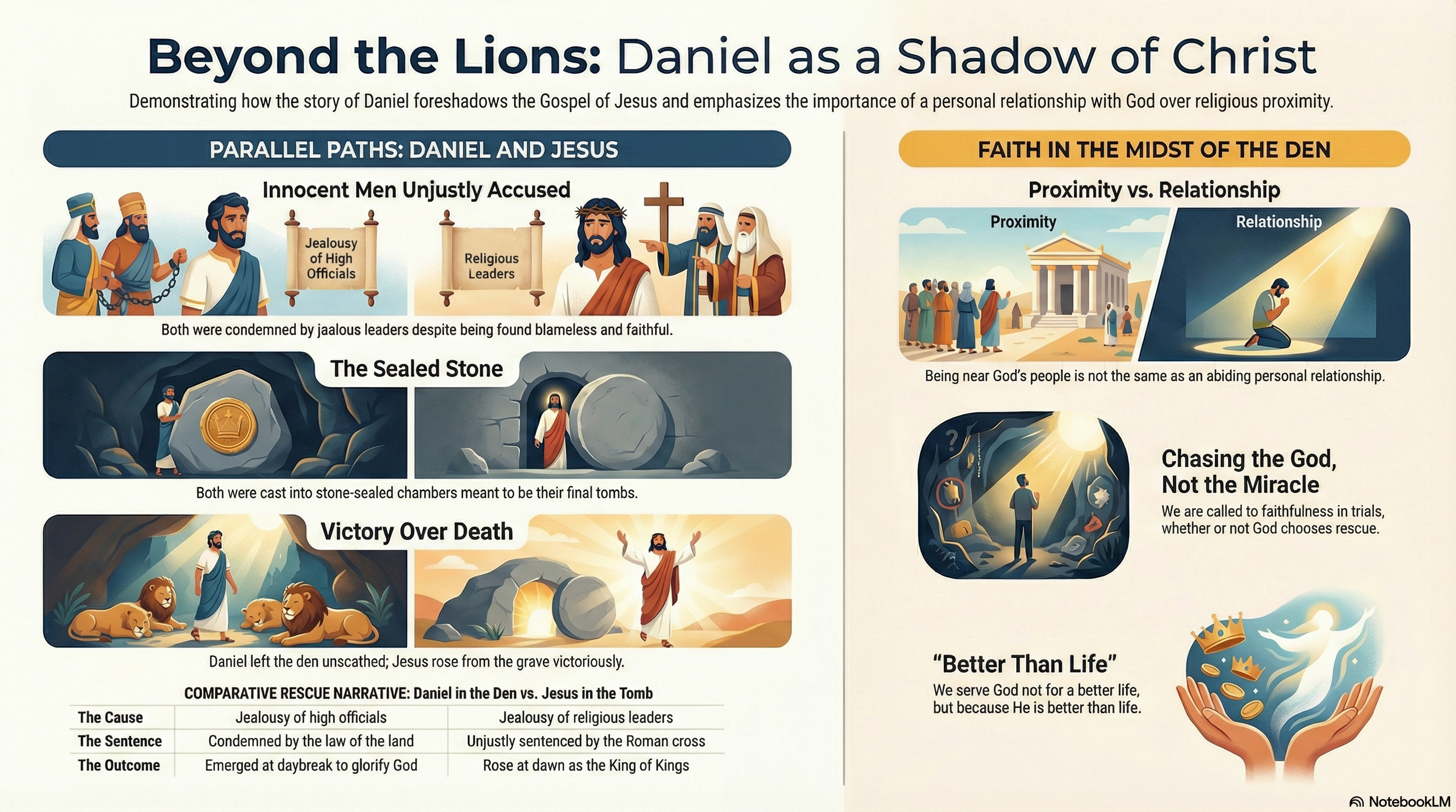
Deep Dive Podcast
Study Guide: Daniel and the Grand Narrative of Rescue
Part I: Short-Answer Quiz
Instructions: Answer the following questions in 2–3 sentences based on the provided text.
What is the central "big question" regarding culture that the speaker addresses throughout the Daniel series?
Why were the other high officials and satraps motivated to plot against Daniel?
Describe King Darius’s personal reaction to Daniel being sentenced to the lions' den.
How does the speaker define "obedient obedience" in the context of Daniel’s life?
What was Daniel’s specific response to the King upon being found alive the morning after his sentencing?
How does the speaker debunk the argument that the lions were simply not hungry when Daniel was in the den?
What was the fate of Daniel’s accusers, and what does the speaker note about the legal context of that time?
According to the sermon, what is the critical difference between "proximity to God" and a "relationship with God"?
How does the speaker use the story of Stephen from the Book of Acts to illustrate God’s presence during trials?
In what way does the "Jesus Storybook Bible" describe the overarching theme of every story in the Scriptures?
--------------------------------------------------------------------------------
Part II: Answer Key
The big question is whether believers should adapt, reject, or accept different parts of the culture in which they live. The series specifically examines what holiness and hope look like in the midst of various cultural environments.
The officials were driven by jealousy because Daniel possessed a legacy of integrity and truthfulness that made the King want to set him over the entire kingdom. They concocted a plan to use Daniel's religious devotion against him, knowing they could find no other fault in his conduct.
Darius had a friendship with Daniel and spent the night fasting, refusing any diversions or sleep. He was in a state of anguish and hurried to the den at daybreak, hoping that Daniel’s God had been able to deliver him.
The speaker describes it as obedience born not out of compliance with rules, but as a response to the character and nature of God. It is the belief that serving God is better than life itself, rather than serving Him just to obtain a better life.
Daniel greeted the King respectfully, saying, "O king, live forever," and credited God for sending an angel to shut the lions' mouths. He asserted his innocence, stating he was found blameless before God and had done no harm to the King.
The speaker points to the fact that when the accusers were thrown into the den later, the lions overpowered them and broke their bones before they even reached the bottom. This demonstrates that the lions were indeed predatory and hungry, reinforcing the miraculous nature of Daniel's survival.
The accusers, their wives, and their children were all cast into the lions' den and killed. The speaker explains that in the Persian Empire, laws were formidable, and the guilt of one individual often resulted in the perishing of their entire kindred.
Proximity involves being near religious activities, such as attending church or listening to Christian music, without personal commitment. An abiding relationship requires a personal connection to Jesus Christ as the "King of kings" and a surrender of one's life to Him.
Stephen’s story shows that God does not always rescue His followers from physical death, as Stephen was stoned despite being full of grace and power. Instead, it illustrates that God is with His people in the midst of trials, using their faithfulness to fulfill His mission.
It states that every story from Genesis to Revelation "whispers the name of Jesus" and forms a cohesive narrative of God's "never stopping, never giving up, unbreaking, always and forever love." The Bible positions Jesus as the central hero of a "cosmic love story" aimed at rescuing His children.
--------------------------------------------------------------------------------
Part III: Essay Questions
Instructions: Use the source context to develop detailed responses to the following prompts.
The Foreshadowing of Christ: Analyze the specific parallels the speaker draws between the experience of Daniel in the lions' den and the death and resurrection of Jesus. How does the speaker use these parallels to argue that Daniel is not the "hero" of the story?
Integrity Under Pressure: Discuss the "test of loyalties" Daniel faced. How did his commitment to his "higher loyalty" affect his relationship with King Darius and his status within the Medo-Persian Empire?
The Purpose of Trials: The speaker acknowledges that the death rate remains "100%" and that God does not always heal or rescue. Based on the sermon, what is the ultimate goal of the trials that godly people face, and how should they respond when a miracle does not occur?
Cultural Context and Ancient Law: Evaluate the speaker’s treatment of the execution of the accusers’ families. How does he reconcile the "shocking" nature of this event with the cultural and legal reality of the Persian Empire at the time?
The "Dawning Light" Metaphor: At the beginning and end of the sermon, the speaker uses the image of a sunrise in the Adirondacks. Explain how this metaphor serves to illustrate the relationship between Old Testament stories and the "Grand Narrative" of the New Testament.
--------------------------------------------------------------------------------
Part IV: Glossary of Key Terms
Abiding Relationship
A deep, personal, and continuous connection with Jesus Christ, contrasted with mere religious attendance or "proximity."
Darius the King
The ruler of the Medo-Persian Empire who befriended Daniel but was manipulated into signing an edict that led to Daniel's arrest.
ESV (English Standard Version)
The specific translation of the Bible used by the speaker for the sermon’s scripture readings.
Grand Narrative
The concept that the entire Bible is one cohesive story of God’s rescue mission through Jesus Christ, rather than a collection of disconnected moral tales.
Injunction/Edict
The law established by Darius, at the prompting of his officials, requiring that for thirty days, petitions be made only to the King or the petitioner would be cast into the lions' den.
Obedient Obedience
A state of faithfulness driven by a love for God’s character rather than a desire for personal gain or rule-following.
Proximity
Being near to God through religious environments or associations without having a personal, saving relationship with Him.
Satraps
High-ranking provincial governors or officials in the Medo-Persian Empire who conspired against Daniel due to jealousy.
Signet
A seal used by the King and his lords to officially close the lions' den, ensuring that the legal situation regarding Daniel could not be changed.
Stephen
A New Testament figure (Acts 6–7) described as being full of grace and power, who was martyred for his faith, serving as an example that God does not always provide a physical rescue.
