
Daniel 6 - Jealousy or Integrity
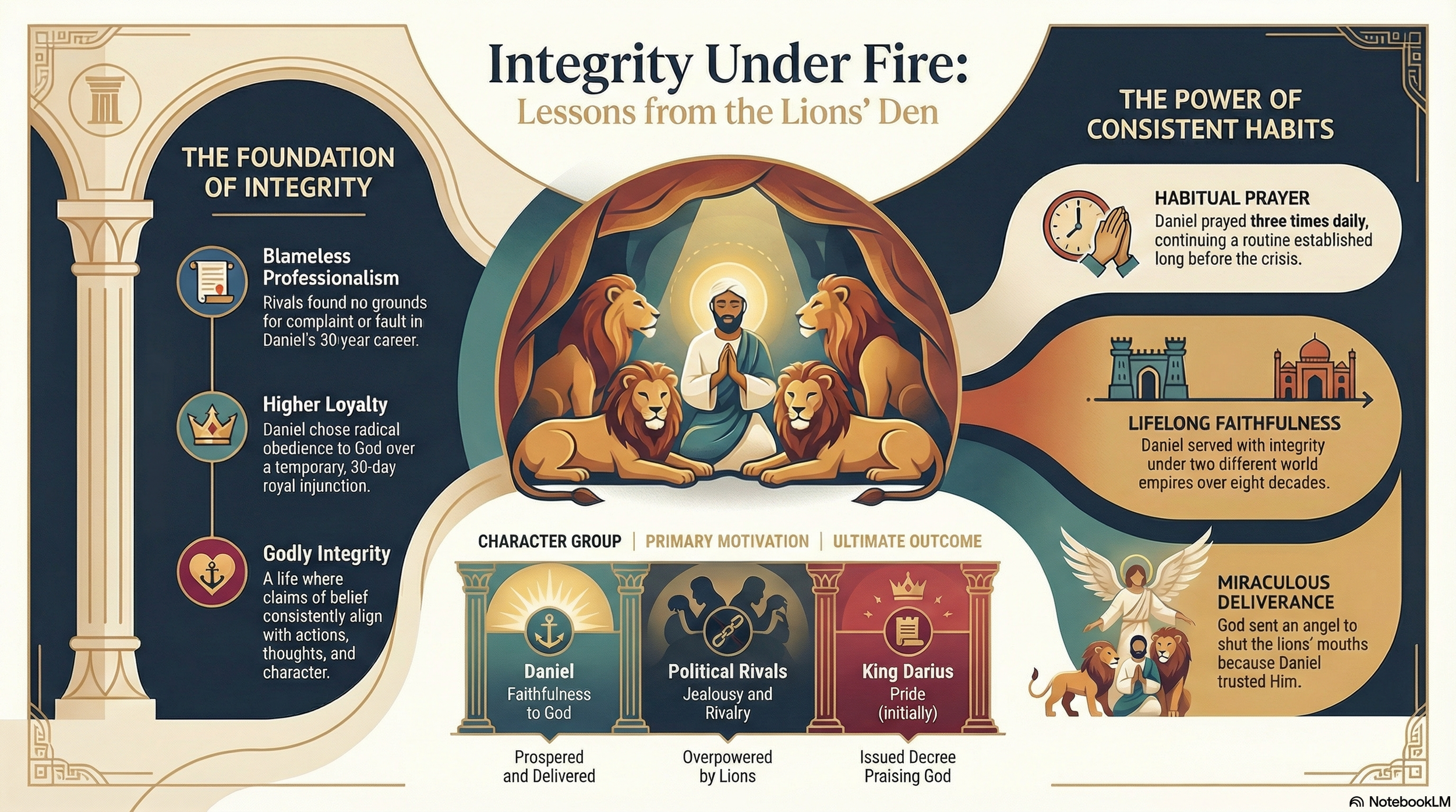
In this week's message, speaker Nathan Mandsager dives into the first half of Daniel chapter 6, exploring Daniel's unwavering faith and godly integrity under the rule of the new Medo-Persian empire. Even when faced with the jealous plots of high officials and a law that threatened his life, Daniel remained radically obedient to God through his consistent, daily habit of prayer. As we navigate our modern counter-biblical culture, this sermon challenges us to examine whether our own habits of time, treasure, and talent reflect the kingdom of this world or the Kingdom of Heaven. Join us as we learn how to cultivate a life of faithful completeness that points others to Jesus, no matter the cost.
Deep Dive Podcast
Study Guide: The Faith of Daniel and the Lions’ Den
This study guide provides a comprehensive review of the biblical narrative of Daniel in the lions' den, supplemented by theological insights from contemporary teaching. It explores themes of jealousy, the irrevocable nature of ancient law, and the power of consistent godly integrity.
Part I: Short-Answer Quiz
Instructions: Answer the following ten questions in 2–3 sentences based on the provided text and sermon transcript.
Why did King Darius intend to set Daniel over the entire kingdom? King Darius was impressed by Daniel’s performance and character, noting that an "excellent spirit" was within him. Daniel had become so distinguished above the other high officials and satraps that the king trusted him to manage the kingdom so that the crown would suffer no loss.
What difficulty did Daniel’s rivals face when trying to find a ground for complaint against him? The high officials and satraps could find no fault, error, or ground for complaint regarding Daniel’s management of the kingdom because he was exceptionally faithful. Consequently, they realized they could only find a grievance against him if it were in connection with the law of his God.
What were the specific requirements and consequences of the injunction signed by King Darius? The decree established that for a period of thirty days, any person who made a petition to any god or man—except for King Darius himself—would be cast into a den of lions. Once signed, this injunction became an irrevocable law of the Medes and the Persians.
According to the sermon transcript, what is the historical and political context of this event? The events take place around 539 BC in Babylon (modern-day Iraq) following the fall of the Babylonian Empire and the rise of the Medo-Persian Empire. Daniel was approximately 83 years old at the time, having served faithfully in exile for over 50 years under two different empires.
How did Daniel react immediately after learning the injunction had been signed? Despite knowing the document was signed, Daniel went to his house and prayed in his upper chamber with the windows open toward Jerusalem. He continued his established routine of kneeling, praying, and giving thanks before God three times a day, just as he had done previously.
Why was King Darius unable to rescue Daniel once the trap was revealed? The Persian Empire functioned as a constitutional monarchy where a law or injunction signed by the king could not be changed or revoked. Even though the king labored until sunset to find a way to deliver Daniel, his own officials reminded him that the law of the Medes and Persians was absolute.
How did King Darius spend the night while Daniel was in the lions’ den? The king returned to his palace and spent the night fasting, refusing any diversions or entertainment. He was unable to sleep and went in haste to the den at the break of day to see if Daniel’s God had delivered him.
What was the outcome for the men who maliciously accused Daniel? By the king’s command, the accusers, along with their wives and children, were cast into the den of lions. Before they even reached the bottom of the den, the lions overpowered them and broke all their bones in pieces.
How does the sermon define "integrity" in the context of Daniel’s life? Integrity is described as "completeness" or an undivided life where one’s beliefs align perfectly with their character, actions, and thoughts. It involves consistently doing the right thing regardless of whether others are watching or if the situation involves suffering.
What is the relationship between "habitual" and "occasional" actions as discussed in the transcript? The transcript posits that the "occasional is always affected by the habitual," meaning that our responses to sudden trials are determined by our daily habits. Godly habits are considered the seeds of godly integrity, and Daniel’s response to the threat of death was a result of his long-ingrained routine of prayer.
--------------------------------------------------------------------------------
Part II: Answer Key
Answer: Daniel’s "excellent spirit" and distinguished service led the king to plan his promotion. Darius wanted to ensure the kingdom suffered no loss by placing it under Daniel's oversight.
Answer: Daniel was so faithful and free of error that his rivals could find no fault in his professional life. They concluded that their only path was to exploit his devotion to the "law of his God."
Answer: The injunction forbade petitions to any god or man except the king for thirty days. The penalty for violating this law was being cast into a den of lions.
Answer: It occurred in 539 BC in the Medo-Persian Empire (modern Iraq) under King Darius. Daniel was an 83-year-old exile who had survived the transition from the previous Babylonian regime.
Answer: Daniel did not change his behavior or hide his worship; he continued to pray three times daily. He remained consistent in his "communion with God" as he had done previously.
Answer: Under the "law of the Medes and the Persians," a royal decree was irrevocable. The king was legally bound by his own signed document, despite his personal distress and friendship with Daniel.
Answer: The king fasted and remained in a state of "anguish," refusing all diversions. He was so troubled by Daniel's situation that "sleep fled from him."
Answer: The accusers and their families were thrown into the den as punishment for their malicious intent. They were killed by the lions before they even hit the floor of the den.
Answer: Integrity is a life that is "undivided, consistent, and true." It is the alignment of belief with action, even in life-and-death situations.
Answer: Our daily habits and routines dictate how we will respond to unexpected trials. Daniel’s consistent prayer life (habitual) prepared him to face the lions' den (occasional) with unwavering faith.
--------------------------------------------------------------------------------
Part III: Essay Questions
The Nature of Jealousy: Using the text as a guide, analyze how jealousy motivated the high officials and satraps. Discuss the sermon’s assertion that jealousy is "toxic" and how it manifests in both ancient and modern contexts.
The Conflict of Loyalties: Daniel was a loyal servant to King Darius but chose to disobey a direct royal injunction. Discuss the principles Daniel used to navigate the conflict between "worldly government" and "godly integrity."
The Power of Consistency: The phrase "as he had done previously" appears in verse 10. Write an essay on the importance of consistent habits and spiritual disciplines in building a life that can withstand external pressure and persecution.
A Study of Darius: Contrast King Darius's initial arrogance in signing the decree with his later distress and final proclamation. How does Daniel’s integrity influence the king’s perspective on the "living God"?
Countercultural Faith: The sermon transcript asks whether the church should "adapt, reject, or accept" parts of the surrounding culture. Using Daniel 6 as a case study, discuss what it means to be "in the world but not of it."
--------------------------------------------------------------------------------
Part IV: Glossary of Key Terms
Term
Definition
Constitutional Monarchy
A system of government where the ruler is bound by established laws that they cannot unilaterally change; specifically referenced regarding the Medo-Persian Empire.
Den of Lions
The place of execution intended for Daniel; it was sealed with a signet to ensure the sentence could not be tampered with.
Excellent Spirit
The quality attributed to Daniel that made him distinguished among his peers and favored by the king.
Exile
The state of being barred from one's native country; Daniel lived as an exile from Judah in Babylon for over 50 years.
Injunction
An authoritative warning or order; in this context, the 30-day decree signed by Darius forbidding prayer to anyone but himself.
Integrity
Derived from the Hebrew idea of "completeness"; a life that is undivided and where beliefs line up with character and actions.
Law of the Medes and Persians
A legal framework noted for being irrevocable and unchangeable once established by the king.
Satraps
Provincial governors in the ancient Persian Empire; 120 were appointed by Darius to oversee the kingdom.
Signet
A seal used by the king and his lords to officially close the mouth of the lions' den, ensuring the situation regarding Daniel remained unchanged.
Upper Chamber
The room in Daniel's house where he prayed with windows open toward Jerusalem, symbolizing his continued devotion to his faith despite his surroundings.
