
Daniel 5 - Pride and Justice
Here, Pastor Tim dives into Daniel chapter 5, where King Belshazzar’s arrogant party is suddenly interrupted by the literal writing on the wall. This sermon explores the dramatic fall of Babylon and the danger of letting power and prestige blind us to God’s sovereignty. As Daniel interprets the king's judgment, we are challenged to examine our own hearts and walk in humility before the God who will not be mocked.
Deep Dive Podcast
Study Guide: Daniel Chapter 5 Pride and Justice
This study guide provides a comprehensive review of Daniel Chapter 5, based on the analysis of King Belshazzar’s reign, his act of blasphemy, and the subsequent divine judgment. It explores the themes of arrogance, humility, and the sovereignty of God as presented in the source transcript.
--------------------------------------------------------------------------------
Short-Answer Quiz
Instructions: Answer the following questions in 2–3 sentences based on the provided text.
What was the historical relationship between King Nebuchadnezzar and King Belshazzar?
What specific act of blasphemy did Belshazzar commit during his great banquet?
Why was King Belshazzar considered a "co-regent," and how did this affect the rewards he offered Daniel?
How did the location of the "writing on the wall" emphasize its supernatural origin?
Describe the physical and emotional reaction of King Belshazzar upon seeing the human hand write on the wall.
According to the Queen, why was Daniel (Belteshazzar) uniquely qualified to help the king?
What was Daniel’s immediate response to the king’s offer of purple clothing and a gold chain?
What happened to King Nebuchadnezzar when his heart became "hardened with pride," and what was the ultimate goal of his suffering?
What were the three specific words written on the wall, and what was their collective meaning?
How did the Medo-Persian Empire successfully infiltrate Babylon on the night of Belshazzar’s death?
--------------------------------------------------------------------------------
Quiz Answer Key
What was the historical relationship between King Nebuchadnezzar and King Belshazzar? While the text refers to Nebuchadnezzar as Belshazzar's "father," it clarifies that several kings ruled between them. Nebuchadnezzar served as a "founding father" or predecessor who established the Babylonian ways and the kingdom that Belshazzar eventually inherited.
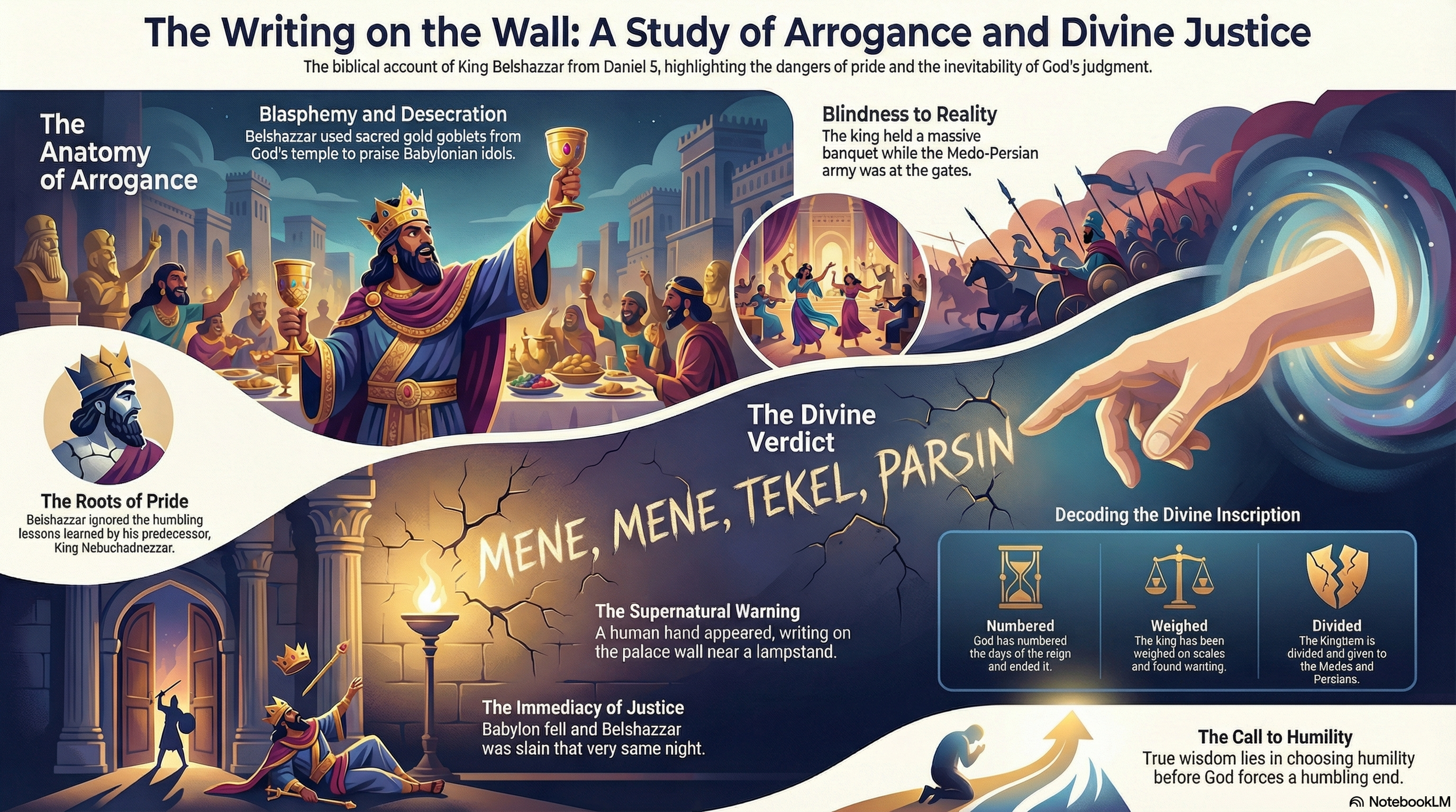
What specific act of blasphemy did Belshazzar commit during his great banquet? Belshazzar ordered the gold and silver goblets taken from the temple in Jerusalem to be brought to the party. He, his nobles, wives, and concubines drank from these sacred vessels while praising man-made gods of gold, silver, bronze, iron, wood, and stone.
Why was King Belshazzar considered a "co-regent," and how did this affect the rewards he offered Daniel? Belshazzar shared authority with his father, meaning they ruled different areas of the kingdom simultaneously. Because he was the second-highest authority, the highest position he could offer Daniel was that of the "third highest ruler" in the kingdom.
How did the location of the "writing on the wall" emphasize its supernatural origin? The hand wrote on the plaster of the wall specifically "near the lampstand." This placement ensured the event was clearly visible and could not be dismissed as a dark illusion or a trick of the shadows.
Describe the physical and emotional reaction of King Belshazzar upon seeing the human hand write on the wall. The king was struck with extreme terror, causing his face to turn pale. His fear was so intense that his legs became weak, his knees knocked together, and his "hips were loosed," rendering him unable to stand firmly.
According to the Queen, why was Daniel (Belteshazzar) uniquely qualified to help the king? The Queen noted that Daniel possessed a "spirit of the holy gods" and had shown extraordinary insight, intelligence, and wisdom during Nebuchadnezzar’s reign. She highlighted his proven ability to interpret dreams, explain riddles, and solve difficult, "knotty" problems.
What was Daniel’s immediate response to the king’s offer of purple clothing and a gold chain? Daniel confidently told the king to keep his gifts or give his rewards to someone else. He demonstrated that he did not serve the king for personal gain or royal status, though he still agreed to provide the interpretation of the writing.
What happened to King Nebuchadnezzar when his heart became "hardened with pride," and what was the ultimate goal of his suffering? Nebuchadnezzar was deposed from his throne, stripped of his glory, and driven away to live like a wild animal, eating grass like an ox. This lasted until he finally acknowledged that the Most High God is sovereign over all earthly kingdoms.
What were the three specific words written on the wall, and what was their collective meaning? The words were Mene, Tekel, and Peres. They signified that God had numbered the days of Belshazzar’s reign, weighed him on the scales and found him wanting, and divided his kingdom to be given to the Medes and Persians.
How did the Medo-Persian Empire successfully infiltrate Babylon on the night of Belshazzar’s death? The Medes and Persians diverted the river that ran through the city into a floodplain. Once the water level dropped sufficiently, their soldiers were able to march underneath the city walls, taking Babylon with very little resistance.
--------------------------------------------------------------------------------
Essay Questions
Instructions: Use the themes and historical data from the text to develop comprehensive responses to the following prompts.
The Danger of Power and Arrogance: Analyze the transcript's assertion that power can make human thinking "unclear." How does Belshazzar’s decision to party while an enemy empire was "crouching at the door" illustrate the blinding nature of arrogance?
The Requirement of Humility: Contrast the path of Nebuchadnezzar with the warnings given to Belshazzar. Why does the text suggest that it is better to "go directly to humbled" rather than following the cycle of pride, fall, and being deposed?
God's Sovereignty and Justice: Discuss the distinction between "God's patience" and "God's silence." How does the sudden judgment of Belshazzar serve as a warning that God "will not be mocked," regardless of how much time passes before justice is served?
Daniel as a Model of Integrity: Evaluate Daniel’s character as he stands before Belshazzar. How does his refusal of royal rewards and his blunt recount of Nebuchadnezzar’s failures reflect his primary allegiance to God over earthly authorities?
Miracles vs. Daily Faithfulness: The text notes that despite witnessing or hearing of miracles, many Babylonian leaders did not truly convert to following the "one true God." Explore the argument that one should look for God in the "day-to-day grind" rather than relying on miraculous signs to sustain faith.
--------------------------------------------------------------------------------
Glossary of Key Terms
Arrogance
A state of pride where individuals think so highly of themselves that they believe they can operate without a connection to the Creator.
Astrologers / Diviners
The group of "wise men" in Babylon summoned by Belshazzar who were unable to read or interpret the divine writing on the wall.
Blasphemy
The act of showing contempt or lack of reverence for God; specifically exemplified by Belshazzar using sacred temple goblets for a pagan party.
Co-regent
A ruler who shares authority with another; in this context, Belshazzar ruled alongside his father, holding the second-highest position.
Darius the Mede
The ruler who took over the kingdom of Babylon at the age of 62 immediately following the death of Belshazzar.
Jerusalem Temple Goblets
Sacred gold and silver vessels taken by Nebuchadnezzar when he sacked Jerusalem; used by Belshazzar to mock the God of Israel.
Mene
A term from the wall inscription meaning "numbered"; signifying that God had determined the end of Belshazzar's reign.
Medo-Persian Empire
The foreign power that was "crouching at the door" of Babylon and eventually conquered the city by diverting its river.
Peres (or Parsin)
A term from the wall inscription meaning "divided"; signifying that the Babylonian kingdom would be split and given to the Medes and Persians.
Purple Clothing
A rare and expensive garment in the ancient world, dyed with rare substances, serving as a symbol of royalty and high honor.
Sovereignty
The supreme power and authority of God over all earthly kingdoms, regardless of the perceived power of human rulers.
Tekel
A term from the wall inscription meaning "weighed"; signifying that the king had been judged and found deficient in character and righteousness.
