
Daniel 4 - Knowing God’s Will
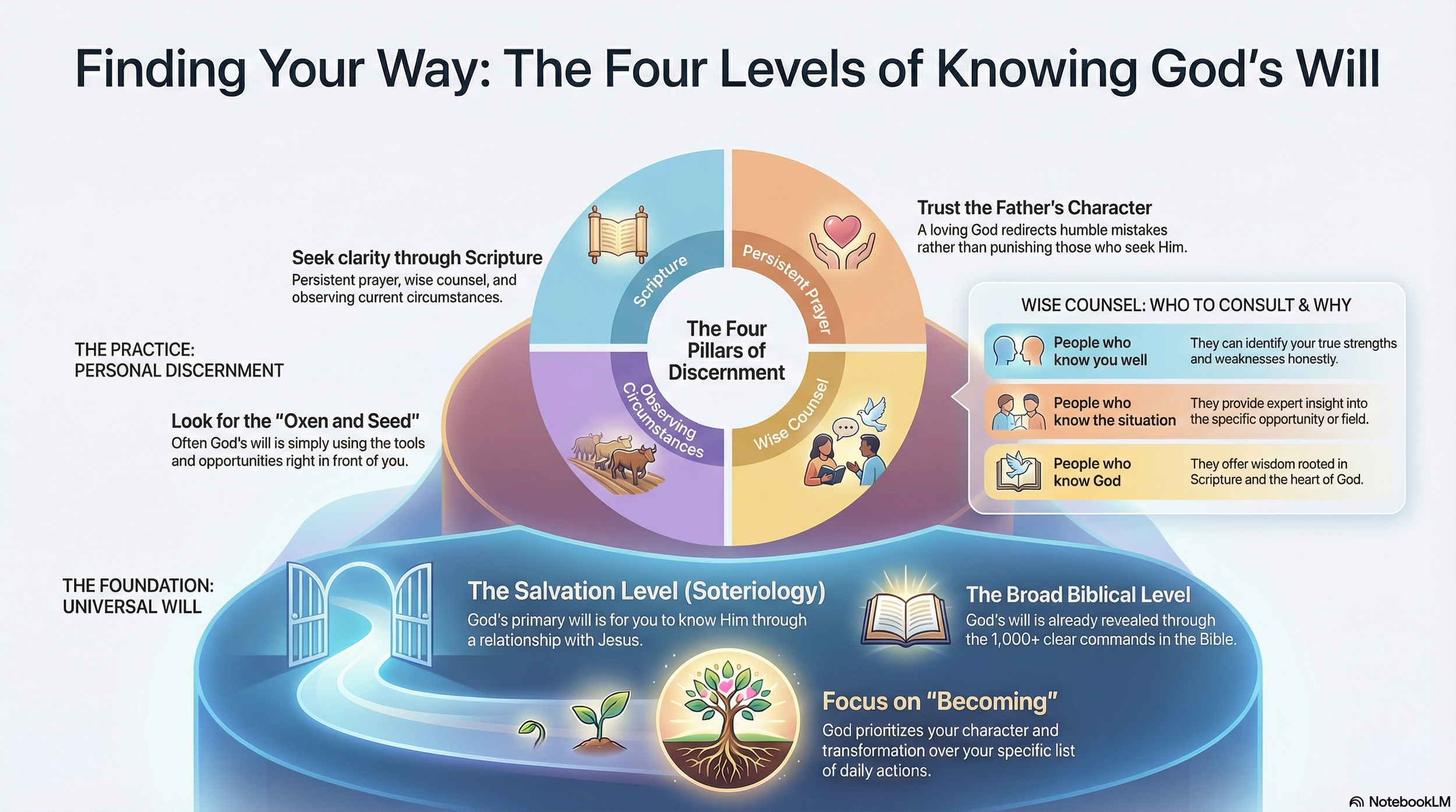
Understanding God’s will involves four levels. First is salvation through Jesus. Second is following biblical commands. Third is trusting God’s good character to redirect us if we fail. Finally, discernment comes through prayer, seeking wise counsel, and observing circumstances.
Deep Dive Podcast
Have you ever found yourself asking, "God, what do you want me to do?" Whether it’s about taking a new job, making a move, or navigating a relationship, discerning God's will is one of the most common questions believers face.
In this message, Pastor Tim takes a brief detour from our study in the Book of Daniel to tackle the topic of Knowing God's Will. While the Book of Daniel shows us God revealing His plans through dreams and visions, how does that apply to us today?
Pastor Tim breaks down the concept of God's will into four levels, moving from the "big picture" down to our specific daily choices:
1. The Soteriological Level (Salvation) Before God is concerned with what car you drive or where you work, He is concerned with your eternity. His ultimate will is that you know Jesus and pass from death to life. Pastor Tim shares a vivid analogy about "turquoise stones and a rattlesnake" to explain why we often focus on the wrong things.
2. The Broad Biblical Level God has already revealed much of His will in the Bible. If Scripture commands it (like loving your neighbor or making disciples), you don't have to guess—that is God's will for you.
3. The Character of God What happens if we try to follow God but get it wrong? Do we serve a God who is waiting to "smite" us, or a Good Father who redirects us? This section encourages us to trust that God is more interested in who we are becoming than simply what we are doing.
4. Practical Discernment When you have to make a specific choice that isn't explicitly in the Bible, how do you decide? Pastor Tim offers a practical "funnel" for decision-making:
• Consult Scripture: Does the Bible speak to the topic?
• Pray: Ask God to shape you and reveal His path.
• Seek Wise Counsel: Don't go it alone—ask people who know you, know the situation, and know God.
• Observe Circumstances: Look at the doors God is opening right in front of you.
Key Takeaway: "God is more concerned about who you are becoming than what you are doing... because if you become the right person, you will do the right things."
Scripture References:
• John 6:40
• Romans 8
• Proverbs 11:14, 12:15, 15:22
• 1 Thessalonians 5:18
Study Guide: Understanding and Discerning the Will of God
This study guide provides a comprehensive overview of the theological and practical framework for understanding God’s will, as presented in the analysis of the Book of Daniel and contemporary biblical application. It explores the four hierarchical levels of God's will, ranging from the universal call to salvation to the specific methods of daily discernment.
--------------------------------------------------------------------------------
Overview of the Four Levels of God’s Will
The search for God’s will is structured into four distinct levels. This hierarchy ensures that specific life decisions are made within the context of a broader relationship with the Divine and an understanding of scriptural truth.
Level 1 - Soteriological
The highest level, focusing on God’s desire for all people to receive salvation and eternal life through Jesus Christ.
Level 2 - Broad Biblical
Following the explicit commands found in the Bible which dictate how a believer should live and interact with the world.
Level 3 - Character of God
Trusting in God’s nature as a good Father who redirects his children rather than punishing them for honest mistakes in discernment.
Level 4 - Discernment
The practical application of wisdom to specific life choices through prayer, scripture, counsel, and circumstances.
--------------------------------------------------------------------------------
Short-Answer Quiz
Instructions: Answer the following questions in 2–3 sentences based on the provided text.
What is the "soteriological level" of God's will?
According to John 6:40, what is the specific will of the Father regarding Jesus?
Explain the "rattlesnake and turquoise stones" metaphor.
What is the difference between giving thanks "in" all circumstances versus "for" all circumstances?
How does the text describe "Biblical Justice" in contrast to "Social Justice"?
Why is the "character of God" considered a crucial level in seeking His will?
What did Saint Augustine mean by the phrase, "Love God, pray and do as you please"?
What role does prayer play in the discernment process beyond simply asking for answers?
According to the text, what three types of people should one consult when seeking wisdom?
Describe the "Oxen and Seed" metaphor regarding God's will.
--------------------------------------------------------------------------------
Answer Key
What is the "soteriological level" of God's will? The soteriological level is the highest and broadest level of God's will, referring to the topic of salvation. It establishes that God’s primary desire is for every individual to be brought from death to life through a relationship with Jesus Christ.
According to John 6:40, what is the specific will of the Father regarding Jesus? The Father’s will is that everyone who looks to the Son and believes in Him shall have eternal life. Furthermore, Jesus promises that He will raise those believers up on the last day.
Explain the "rattlesnake and turquoise stones" metaphor. The metaphor illustrates that God is more concerned with life-and-death spiritual matters (the rattlesnake bite/salvation) than with minor life details (choosing turquoise stones/specific jobs or cars). It warns against focusing on trivial decisions while ignoring the urgent need for a relationship with God.
What is the difference between giving thanks "in" all circumstances versus "for" all circumstances? The Bible commands believers to give thanks in all circumstances, meaning maintaining a grateful heart regardless of the situation. It does not require them to give thanks for the circumstances themselves, which may include suffering or evil.
How does the text describe "Biblical Justice" in contrast to "Social Justice"? Biblical justice is framed by the understanding that every person is made in the image of God (Genesis 1) and seeks to usher in Shalom, a state of peace and proper operation. The text suggests avoiding the term "social justice" due to its heavy political implications, focusing instead on honoring people and restoring peace biblically.
Why is the "character of God" considered a crucial level in seeking His will? Understanding God's character prevents believers from living in paranoia or fear of "missing" His will and being punished. If one views God as a good Father, they can trust that He will gently redirect them if they make an honest mistake while seeking Him.
What did Saint Augustine mean by the phrase, "Love God, pray and do as you please"? This quote suggests that if a person truly loves God and stays in communication with Him through prayer, their desires will naturally align with His. Consequently, their choices (doing as they please) will inherently fall within the boundaries of God's will.
What role does prayer play in the discernment process beyond simply asking for answers? Prayer is described as a refining process where God molds and shapes the individual's character. Often, God is more concerned with who the person is becoming through prayer than with providing a direct "yes" or "no" to a specific request.
According to the text, what three types of people should one consult when seeking wisdom? One should seek out people who know them well enough to speak hard truths, people who have deep knowledge of the specific situation or field in question, and, most importantly, people who intimately know God and His Word.
Describe the "Oxen and Seed" metaphor regarding God's will. The metaphor describes a person asking for God’s will while standing in a field with all the tools necessary—oxen, seed, and land—already provided. It suggests that often God’s will is not mysterious or hidden but is simply the obvious task right in front of the person that needs to be done.
--------------------------------------------------------------------------------
Essay Questions
The Priority of Being over Doing: Analyze the argument that God is more concerned with who a person is "becoming" than what they are "doing." How does this perspective change the traditional approach to seeking divine guidance?
The Safety of Counsel: Discuss the biblical role of community in discernment. Why is it considered "dangerous" to rely solely on oneself when trying to identify God's will?
The Character of the Father: Contrast the "detention/punishment" view of God with the "Good Father" view presented in the text. How does one's internal perception of God's character affect their ability to take risks in faith?
The Nuance of Scriptural Application: Using the examples of the 1,050 commands in the New Testament, discuss how a believer distinguishes between universal divine wills (like making disciples) and specific historical context (like greeting Priscilla).
Providence and Circumstances: Explore the role of sovereign circumstances in the life of Daniel and how modern believers can use their current location, skills, and "open doors" to identify their purpose.
--------------------------------------------------------------------------------
Glossary of Key Terms
Biblical Justice: The act of honoring all people as beings made in the image of God and working to establish Shalom (peace and order) as called for in the Old and New Testaments.
Discernment: The practical process of using scripture, prayer, wise counsel, and circumstantial observation to identify the best course of action in specific situations.
Refining: A biblical metaphor for spiritual growth that often involves "fire" or trials to hammer, hurt, and eventually mold a person into a shape God can use for His purposes.
Soteriology: The study of religious doctrines of salvation; in this context, the highest level of God's will concerning the rescue of humanity through Jesus Christ.
Shalom: An Old Testament concept referring to a place of peace, wholeness, and things operating in the way they were intended to operate.
The Just Shall Live by Faith: A biblical principle from Romans and Habakkuk stating that God's people must trust Him even when they do not have a "tidy little box" of answers regarding His plans.
Woowoo: A colloquial term used in the text to describe the subjective or mystical aspects of discernment, such as receiving internal pictures, senses, or ideas during prayer.
