
Joseph: Obedience in God’s Perfect Plan
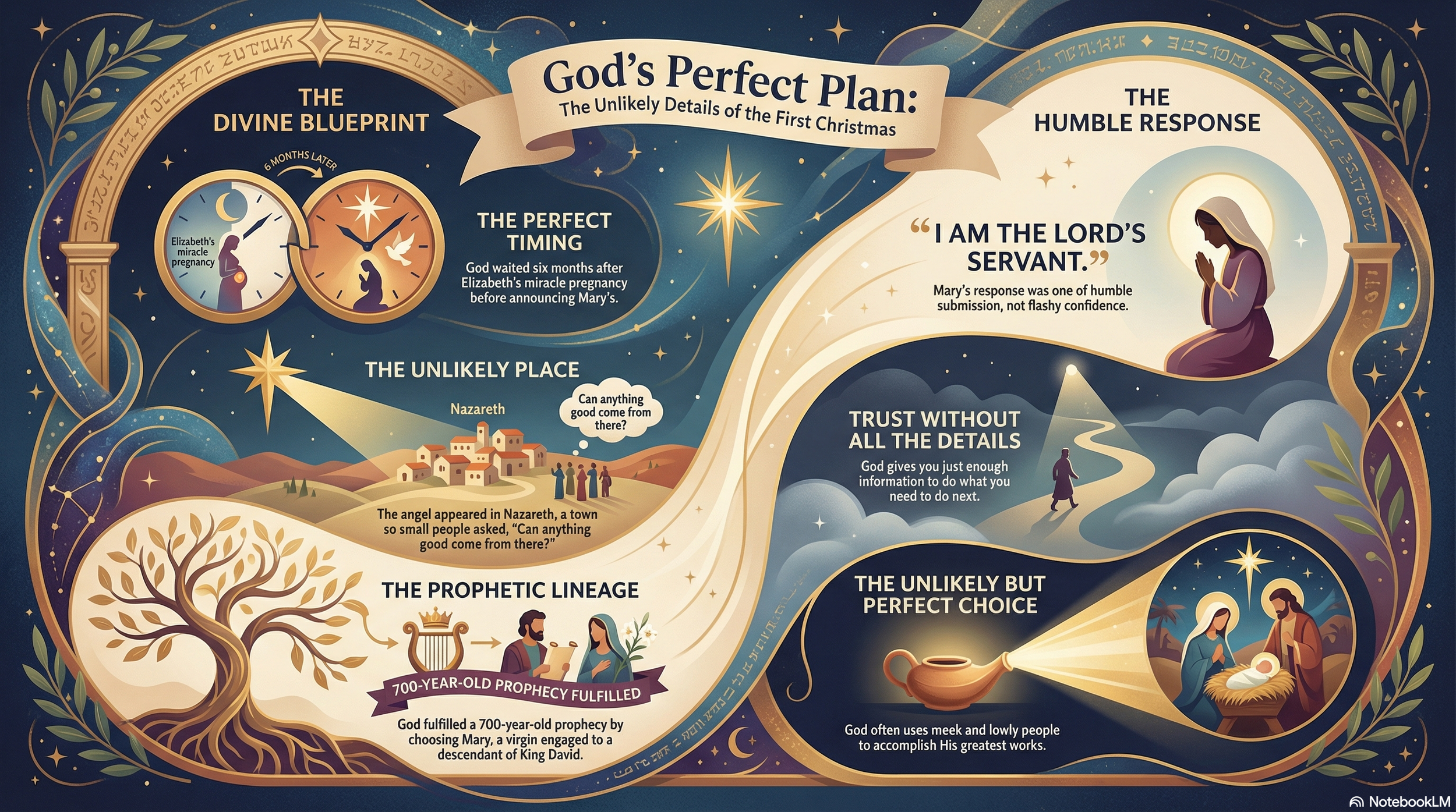
Continuing a sermon series about "God's perfect plan" during the Christmas season of 2025. The core focus of this particular message is the life of Joseph, the earthly father of Jesus, as described in Matthew chapter one, verses 18-25. Pastor Tim emphasizes the dual nature of God's work, which is seen in both the ordinary and the extraordinary aspects of Joseph's story, contrasting the natural creation of a family with the supernatural conception of Jesus through the Holy Spirit.
Deep Dive Podcast
Study Guide: The Life of Joseph and God's Perfect Plan
This guide is based on a sermon by Pastor Tim from a series on "God's perfect plan," delivered during the Christmas 2025 season. The sermon focuses on the life of Joseph, the earthly father of Jesus, as detailed in the biblical passage Matthew 1:18-25. It explores themes of faith amid confusion, the interplay of God's work in ordinary and extraordinary ways, and the nature of obedience.
--------------------------------------------------------------------------------
Short Answer Quiz
Answer the following questions in 2-3 complete sentences, based on the provided sermon text.
What is the central theme of the sermon series, and which biblical figure was the focus of the previous week's sermon?
What are the two contrasting concepts that Pastor Tim uses to frame God's perfect plan in the life of Joseph?
According to the sermon, how did the cultural understanding of being "pledged" or "betrothed" differ from a modern engagement?
What two character traits did Joseph display in his initial plan to divorce Mary quietly, according to the text in verse 19?
What specific instructions did the angel of the Lord give to Joseph in his dream?
How does the sermon explain the relationship between fear and courage, using Mary and Joseph as examples?
What prophecy from the book of Isaiah is quoted in Matthew 1:22-23, and what does the name "Emmanuel" mean?
Pastor Tim warns against a modern cultural trend regarding Jesus. What is this trend, and how does the sermon define the central purpose of Jesus' life?
What is the key lesson the sermon draws from Joseph's obedience after waking from his dream, particularly regarding the timing of results?
What evidence from the Bible does Pastor Tim provide to support the scholarly belief that Joseph died before Jesus' crucifixion?
--------------------------------------------------------------------------------
Answer Key
The central theme of the sermon series is "God's perfect plan," particularly as seen in the Christmas story. The previous week's sermon focused on the life of Mary, highlighting her humble response to the news that she would be the mother of Jesus and God's perfect timing in the announcement.
Pastor Tim frames God's perfect plan using the concepts of the "ordinary" and the "extraordinary." He explains that God works through both standard, everyday means (like marriage creating a family) and supernatural, miraculous events (like the conception by the Holy Spirit).
In the culture of the time, being "pledged" or "betrothed" was considered equivalent to being married and was expected to last a couple of years. Breaking a betrothal was a serious act, considered equivalent to a divorce, not a simple change of plans.
Joseph's plan to divorce Mary quietly showed that he was a man who wanted to be "faithful to the law" but also wanted to show mercy. He sought to do the right thing according to the law without exposing Mary to public disgrace.
The angel told Joseph not to be afraid to take Mary as his wife because the child was conceived by the Holy Spirit. The angel instructed him that Mary would give birth to a son and that Joseph was to give him the name Jesus, "because he will save his people from their sins."
The sermon explains that courage requires the presence of fear; without fear, an act does not necessitate courage. The issue is not the presence of fear itself, but one's response to it. Mary and Joseph both had reason to be afraid, but they demonstrated courage by choosing to trust God and "lean in" to His plan despite their fear.
The sermon quotes the prophecy from Isaiah chapter 7: "The Virgin will conceive and give birth to a son, and they will call him Emmanuel." Pastor Tim explains that the name Emmanuel means "God with us."
The trend is to take one piece of Jesus (e.g., as a great teacher) and discard the rest, such as the concept of the "universal Christ." The sermon defines the central purpose of Jesus' life as offering redemption to the world by saving his people from their sins, a mission that culminated in his death on the cross.
The key lesson is that obedience does not always lead to immediate results. Joseph obeyed what the angel commanded, but he had to wait months before he could see the fulfillment of God's plan, living with uncertainty in the interim. This teaches that followers of God must sometimes step forward in obedience and trust, with the results coming later.
The sermon points to several instances where Joseph is conspicuously absent. These include Jesus at the wedding in Cana (John chapter 2), a discussion of Jesus' mother and brothers, and Jesus entrusting his mother Mary to the care of John from the cross, which implies her husband was no longer there to care for her.
--------------------------------------------------------------------------------
Essay Questions
Reflect on the sermon's themes and construct a detailed essay response to the following prompts. Do not provide answers.
Analyze Pastor Tim's framework of the "ordinary" and the "extraordinary." How does he use the story of Joseph's family and his personal story about his son Hudson to illustrate that God operates in both spaces?
The sermon states, "Sometimes our hearts are broken before we see what God is doing." Discuss this theme in relation to Joseph's experience. How does Pastor Tim use Joseph's brokenhearted yet faithful response to encourage modern listeners?
Explore the sermon's emphasis on the specific identity and mission of Jesus as prophesied in Isaiah 7 and Isaiah 53. How does this detailed prophecy, given 700 years before Jesus' birth, serve as a cornerstone for the sermon's argument about God's perfect plan and the purpose of Christmas?
Discuss the role of obedience in the face of doubt and delayed results as seen in the life of Joseph. How does the sermon argue that this type of faithfulness may not see its full reward "on this side of eternity," and why is this concept presented as a deep form of faith?
Examine the character of Joseph as presented in the sermon. What specific actions and attitudes demonstrate his desire to be both faithful to the law and merciful, and how does his journey from considering a quiet divorce to becoming Jesus' earthly father exemplify trust and courage?
--------------------------------------------------------------------------------
Glossary of Key Terms
Term / Name
Definition
Joseph
The earthly father of Jesus, betrothed to Mary. The sermon presents him as a man faithful to the law, merciful, and obedient to God despite having his heart broken and facing great uncertainty.
Mary
The mother of Jesus. The previous sermon focused on her humble response and God's perfect timing in announcing her pregnancy.
Pastor Tim
The speaker delivering the sermon on the life of Joseph as part of a series on God's perfect plan.
Matthew 1:18-25
The primary biblical text for the sermon, which recounts the events surrounding Mary's pregnancy, Joseph's initial reaction, the angel's visit to Joseph in a dream, and the birth of Jesus.
Isaiah 7 & 53
Prophetic books from the Old Testament written approximately 700 years before the birth of Jesus. Isaiah 7 prophesies the virgin birth ("Emmanuel"), and Isaiah 53 is quoted at length as a detailed prophecy of Jesus' suffering, death, and role in bearing the sins of humanity.
Betrothal
A pledge to be married that, in the culture of the time, was legally equivalent to marriage and lasted for an extended period, typically a couple of years. To break a betrothal was as serious as a divorce.
Ordinary and Extraordinary
The two ways Pastor Tim describes God's operation in the world. The "ordinary" refers to common, everyday means (like marriage), while the "extraordinary" refers to supernatural or miraculous events (like the virgin conception).
A Sense on the Heart
A phrase from the preacher Jonathan Edwards. Pastor Tim uses it to describe his hope that listeners will leave the sermon with something deep and profound to ponder about God's perfect plan.
Emmanuel
A name for Jesus prophesied in Isaiah, which is quoted in the sermon. It means "God with us."
Universal Christ
A modern theological trend mentioned in the sermon. It is described as focusing on the "heart and ideas of Jesus" as a universal concept, separate from the actual person of Jesus who came to save people from their sins.
Jonathan Edwards
An influential preacher from the early history of the United States, cited by Pastor Tim for his concept of giving people "a sense on the heart."
Dr. Bill Sutherland
An orthopedic surgeon and friend of Pastor Tim who provided medical advice and a recommendation for another surgeon after Pastor Tim's son's accident.
Hudson
Pastor Tim's son, whose accidental hand injury with an ax is used as a personal story to illustrate the intersection of God's work in ordinary and extraordinary ways.
