
God’s Perfect - Detailed Plan
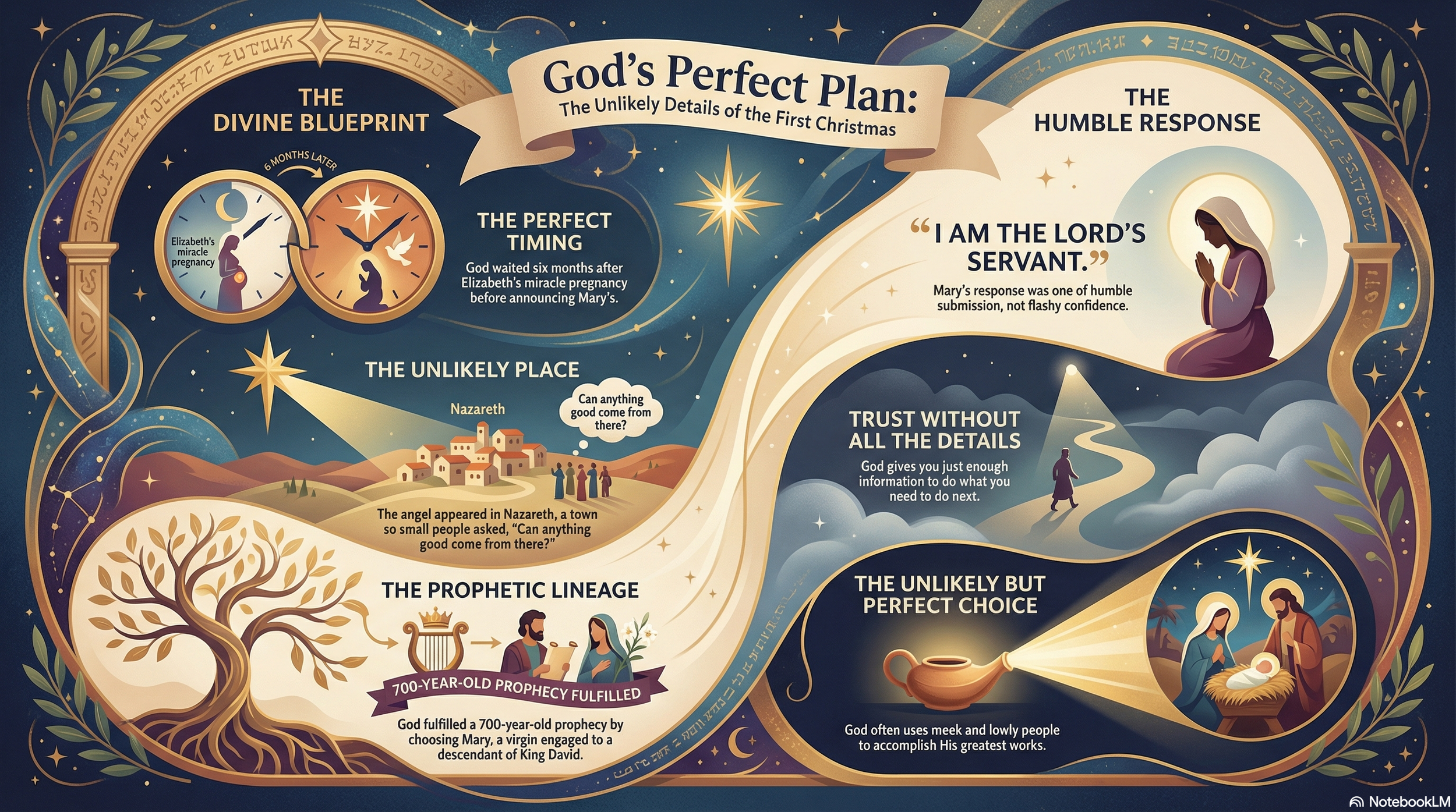
Pastor Tim at the start of the Advent season, urges us to approach the familiar story of Jesus's birth with a fresh sense of wonder and appreciation. He centers his message on the theme that the Christmas narrative reveals God’s perfect, detailed plan, which meticulously aligned people and circumstances across centuries. This flawless arrangement is illustrated through the specific timing of the angel Gabriel’s visit to Mary and the seemingly insignificant choice of her hometown, Nazareth, which nonetheless fulfilled ancient prophecies. Pastor Tim uses the account of Mary’s interaction with the angel to emphasize that God sees the righteous lives of His people and offers strong affirmation before asking for challenging obedience. Ultimately, he presents Mary's humble response—declaring herself the Lord's servant—as the ultimate example of submission, trusting that God orchestrates every necessary detail.
Deep Dive Podcast
Advent Sermon Study Guide: The Annunciation to Mary
Short-Answer Quiz
Answer the following questions in 2-3 sentences each, drawing exclusively from the provided source material.
What is the definition of "Advent" as explained in the sermon, and what is its primary focus?
The sermon identifies a "danger" associated with the familiarity of the Christmas story. What is this danger, and what is the desired alternative experience?
According to the pastor, how does the Christmas story connect to the story of creation and the promise made to Eve?
Explain the significance of the timing of the angel Gabriel's visit to Mary in relation to her relative, Elizabeth.
Describe the town of Nazareth as presented in the sermon and explain the irony of Nathaniel's later comment about it.
What two specific, centuries-old prophecies are mentioned in the sermon that were fulfilled by the circumstances of Jesus's birth?
How did the angel Gabriel initially greet Mary, and why was this greeting of affirmation so important?
When Mary questioned how she could conceive, what explanation did the angel provide, and what principle does this illustrate about the information God gives?
What was Mary's final response to the angel, and how does it contrast with what the sermon describes as a modern "leadership obsessed culture"?
The pastor argues that God often uses the "meek and lowly." How do the selections of Mary and the nation of Israel illustrate this point?
--------------------------------------------------------------------------------
Answer Key
What is the definition of "Advent" as explained in the sermon, and what is its primary focus? Advent is defined as a time when something new arrives or is arriving. The primary focus of the Advent season is anticipating and celebrating the arrival of Jesus on Christmas.
The sermon identifies a "danger" associated with the familiarity of the Christmas story. What is this danger, and what is the desired alternative experience? The danger is that the story can become so familiar that people take it for granted. The desired alternative is to experience a new sense of wonder and be caught up in amazement at the reality of the Son of God being born as a baby.
According to the pastor, how does the Christmas story connect to the story of creation and the promise made to Eve? The Christmas story is the culmination of a story that began at creation. After humans rebelled against God, God promised Eve that one of her offspring would crush the head of the serpent and destroy death itself; Christmas celebrates the arrival of that child, Jesus.
Explain the significance of the timing of the angel Gabriel's visit to Mary in relation to her relative, Elizabeth. God waited until Elizabeth was six months pregnant before telling Mary she would conceive Jesus. This timing was a gift to Elizabeth, who had been unable to conceive, allowing her to have her moment without being immediately "one-upped" by Mary's news that her son was the Messiah.
Describe the town of Nazareth as presented in the sermon and explain the irony of Nathaniel's later comment about it. Nazareth was a tiny, insignificant town of only 200-400 people, described with modern equivalents like "Podunk" or "hick." The irony is that an early follower named Nathaniel later asked, "Can anything good come from Nazareth?" when, in fact, the greatest good—Jesus—came from there.
What two specific, centuries-old prophecies are mentioned in the sermon that were fulfilled by the circumstances of Jesus's birth? The first prophecy, from Isaiah about 700 years prior, stated that the Messiah would be born to a virgin. The second prophecy was that the Messiah would come through the lineage of King David, which was fulfilled by Joseph, the man Mary was pledged to marry.
How did the angel Gabriel initially greet Mary, and why was this greeting of affirmation so important? Gabriel greeted Mary with affirmations: "Greetings, you are highly favored. The Lord is with you." This kind, encouraging greeting was important because it built Mary up before the angel "dropped the bomb" with the monumental news that she would give birth to the Son of God.
When Mary questioned how she could conceive, what explanation did the angel provide, and what principle does this illustrate about the information God gives? The angel explained simply that the Holy Spirit would come upon her and the power of the Most High would overshadow her. This illustrates the principle that God tells people all they need to know to do what they need to do, providing the necessary information without drowning them in theological details they don't need at that moment.
What was Mary's final response to the angel, and how does it contrast with what the sermon describes as a modern "leadership obsessed culture"? Mary's response was one of humble submission: "I am the Lord's servant... May your word to me be fulfilled." This contrasts with a modern culture that idolizes leadership, fame, and being the "best," whereas Mary's humility demonstrates a focus on God's will rather than personal status.
The pastor argues that God often uses the "meek and lowly." How do the selections of Mary and the nation of Israel illustrate this point? Mary was an "unlikely choice" from a tiny town, not a big or flashy person. Similarly, God chose the "puny nation" of Israel to represent him to the world, rather than a powerful empire like Egypt or Rome, demonstrating His preference for using the humble so that His power is evident.
--------------------------------------------------------------------------------
Essay Questions
Reflect on the core themes of the sermon and construct a detailed essay response for each of the following prompts. Do not provide answers.
The pastor repeatedly uses the phrase, "God didn't have to make it this way, but he did," to emphasize God's perfect, intentional plan. Analyze how this theme is developed throughout the sermon, using at least three specific examples from the text (e.g., the timing of the announcement to Mary, the fulfillment of prophecies, Gabriel's specific greeting) to illustrate God's intricate attention to detail.
Discuss the concept of trust as a central message of the sermon. How does the narrative of Mary's experience, coupled with the pastor's application points, challenge the listener to trust that God is "in the details" of their own lives, even when they lack a full explanation or understanding?
The sermon draws a sharp contrast between Mary's humble submission ("I am the Lord's servant") and a modern "leadership obsessed culture." Elaborate on this contrast. How does the sermon argue that God's power is often made perfect through the "meek and lowly" rather than the "big and flashy," and what is the personal challenge this presents?
Explain the role of Scripture and God's Word as presented in the sermon. How does the angel's proclamation to Mary serve as a parallel for how modern believers can hear from God, and what is the relationship between knowing God's Word and trusting that it "will never fail"?
Analyze how the pastor uses specific details from the biblical text—such as the geography of Nazareth, Joseph's lineage, and the meaning of Jesus's name—to build a comprehensive argument for the deliberate and perfectly aligned nature of the Christmas story.
--------------------------------------------------------------------------------
Glossary of Key Terms
Term
Definition from the Source Context
Advent
The season when something new arrives or is arriving; a time of anticipating and celebrating the arrival of Jesus.
David
An ancient king of Israel. The Messiah was prophesied to come from his lineage, which Joseph, Mary's betrothed, was a descendant of.
Elizabeth
A relative of Mary who was said to be unable to conceive but miraculously became pregnant with John the Baptist in her old age.
Gabriel
The angel God sent to Nazareth to announce to Mary that she would be the mother of Jesus.
Galilee
The region in which the town of Nazareth was located.
Isaiah
A prophet who, approximately 700 years before the event, prophesied that the Messiah would be born to a virgin.
Jacob's descendants
A term used to refer to the nation of Israel, over whom the Messiah would reign forever.
Jesus
The name Mary was instructed to give her son. It is the Jewish name Joshua or Yeshua and means "God saves." He is the Son of God and the Messiah.
John the Baptist
The son of Elizabeth, who would be the forerunner of the Messiah.
Joseph
A descendant of King David to whom the virgin Mary was pledged to be married.
Luke, Gospel of
The book of the Bible containing the account of the angel's visit to Mary, specifically in chapter one.
Mary
A virgin from Nazareth, pledged to Joseph. She was chosen by God to be the mother of Jesus and is described as the "Lord's servant."
Messiah
The prophesied savior who would come through the lineage of David and be born of a virgin. Jesus is identified as this Messiah.
Nathaniel
An early follower of Jesus who, upon hearing Jesus was from Nazareth, expressed skepticism by asking, "Can anything good come from Nazareth?"
Nazareth
A very small and insignificant town in Galilee with an estimated population of 200-400 people. It was Mary's hometown.
