
I AM The Good Shepherd
Join Nathan Mandsager at Mercy Church as we continue our seven-week series exploring the powerful "I Am" statements of Jesus. In this message focused on John 10, we dive into what it truly means for Jesus to be the "Good Shepherd" who relentlessly pursues, protects, and tenderly cares for His flock. Discover how Christ's perfect leadership offers a vital alternative to the worldly distractions, ideologies, and false shepherds that compete for our hearts today. Tune in to learn how to recognize His voice, accept His radical grace, and experience the abundant life He promises to those who follow Him.
Deep Dive
Chapters:
0:00 - Welcome, Prayer Setup & 'I Am' Series Context
2:33 - The Profound and Offensive Nature of Jesus' 'I Am' Claims
4:08 - The Divine Authority Behind 'I Am'
5:07 - Understanding the Good Shepherd in Ancient Jewish Society
6:24 - Jesus Declares 'I Am the Door & the Good Shepherd' (John 10)
13:44 - Jesus Knows His Own & Lays Down His Life
15:30 - Practicalities of Good Shepherding: Proper Feeding and Training
18:51 - Proper Care: Anointing with Oil & Protection
22:59 - The Tender & Tough Shepherd: Pursuing the Lost and Protecting from All Harm
26:46 - Identifying Your Shepherd: A Call to Worship and Obedience
Understanding Jesus as the Good Shepherd: A Study Guide
This study guide examines the biblical metaphors and cultural contexts presented in the sermon "I Am the Good Shepherd," based on John 10. It explores the divine identity of Jesus, the practical realities of ancient shepherding, and the spiritual implications for modern followers.
Part I: Short-Answer Quiz
Instructions: Answer the following questions in 2–3 sentences based on the information provided in the source text.
What is the linguistic and theological significance of the phrase "I Am" as used by Jesus?
How does the speaker describe the cultural reception of Jesus’ "I Am" claims in 2026?
Why does the Bible frequently use sheep as a metaphor for human beings?
What were three practical commodities or services that sheep provided in ancient Jewish society?
According to the sermon, how did ancient shepherds use music (like David’s harp) to care for their flock?
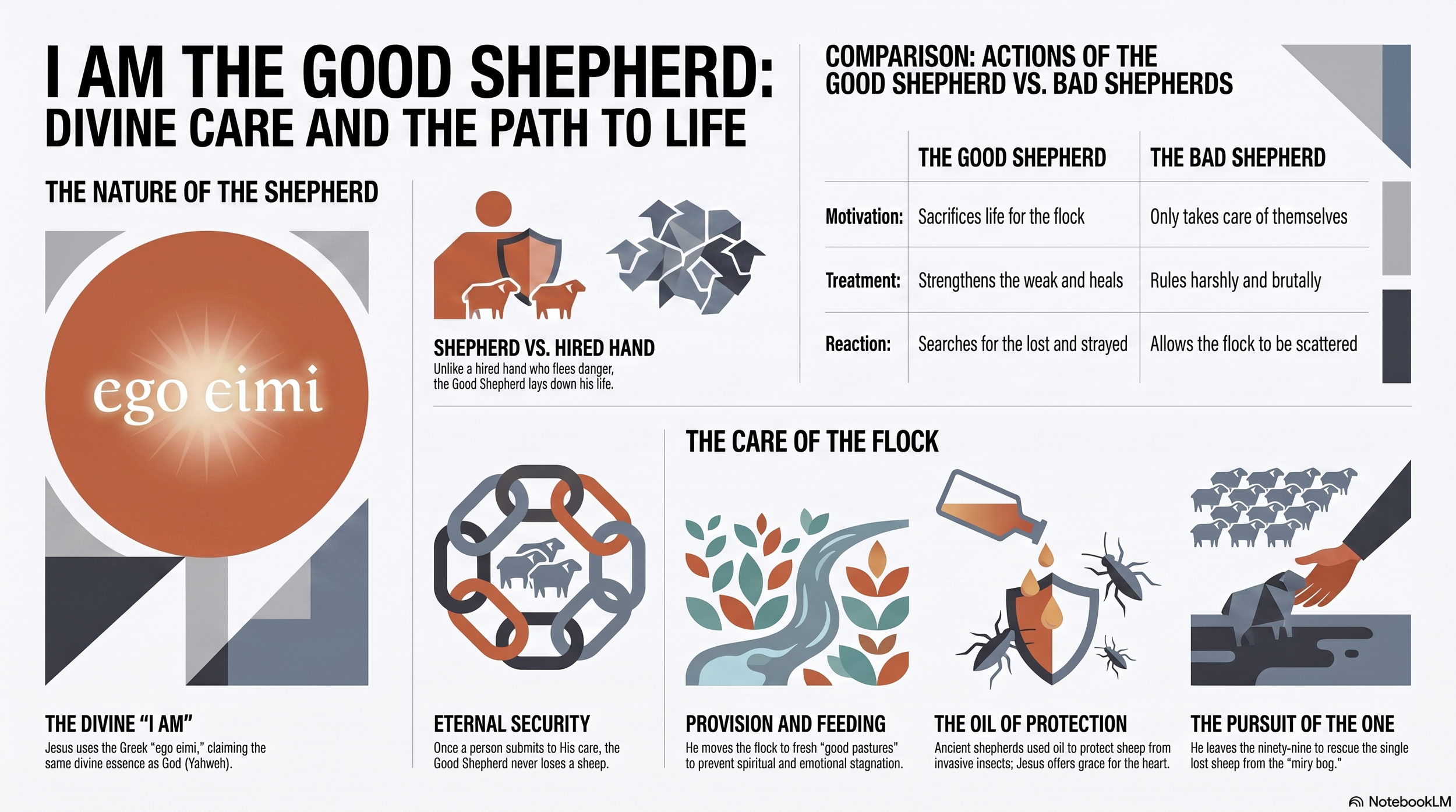
What is the primary difference between a "good shepherd" and a "hired hand" when facing danger?
How does the speaker interpret the practice of "anointing the head with oil" mentioned in Psalm 23?
What does the speaker suggest is the purpose of "breaking" in a believer's relationship with Jesus?
According to the analysis of Ezekiel 34, what are the characteristics of "bad shepherds"?
What is the significance of the "exclusively inclusive" nature of Jesus’ invitation?
Part II: Answer Key
The phrase alludes to the Greek and Old Testament name for God, Yahweh, established at the burning bush in Exodus 3. It is not merely a descriptor of Jesus' occupation but a divine pronouncement of the essence of His character as God.
In modern Western culture, these claims can be perceived as "profoundly offensive" because they challenge the cultural norm of being the "God of one's own life." Jesus' claim to be the exclusive way, truth, and life contradicts the desire for total individual autonomy.
The speaker notes that sheep are often perceived as "dumb," smelly, and prone to wandering off into danger. This comparison highlights human tendencies toward rebellion, poor decision-making, and the constant need for guidance and protection.
Sheep were a vital commodity providing wool for clothing and meat for food. Additionally, they served as a form of "cash" or wages for payments, were used in legal contracts, and were essential to the Jewish sacrificial system.
Music was used to provide a "calming feeling" for the sheep. Because sheep are described as emotional beings, a calm environment was necessary for them to remain healthy and reproduce.
A good shepherd owns the sheep and is willing to lay down his life for them. In contrast, a hired hand does not own the sheep and will flee when he sees a wolf coming, leaving the flock to be snatched and scattered.
In ancient times, shepherds used oil to protect sheep from insects that would crawl into their nostrils to plant eggs, which could drive a sheep to kill itself by banging its head against rocks. In a spiritual sense, this represents receiving the "oil of grace and mercy" to protect the mind from destructive thoughts.
The speaker suggests that Jesus sometimes "breaks" habits, relationships, or priorities to train a follower to hear His voice. This process, though painful, is intended to form the individual into a more faithful and connected follower.
Bad shepherds are characterized by self-interest, taking for themselves (eating curds and wearing wool) while failing to strengthen the weak or heal the sick. They rule "harshly and brutally," allowing the flock to be scattered and become prey for wild animals.
Jesus is "exclusive" because He claims to be the only door or way to salvation. However, He is "inclusive" because that invitation is open to "anyone" who chooses to enter through Him.
Part III: Essay Questions
Instructions: Use the source context to develop comprehensive responses to the following prompts.
The Shepherd’s Duality: Discuss the speaker's claim that Jesus is both "tender and tough." How do the images of the shepherd pursuing a lost sheep (Luke 15) and the shepherd fighting off wolves (John 10) illustrate this balance?
The Danger of "Bad Pastures": The sermon warns that humans often "bend themselves toward bad pastures." Analyze what these metaphorical pastures represent in modern life and the spiritual consequences of "feeding" on the wrong ideas or ideologies.
Identity and Authority: Explore the relationship between the "I Am" statements and Jesus' authority to "lay down his life" and "take it up again." How does this divine authority differentiate Jesus from other "shepherding" influences like political parties or careers?
The Theology of Pursuit: Using the references to Psalm 40 and the Parable of the Lost Sheep, explain the speaker's argument that believers do not "clean themselves up" to get to God. What role does the Shepherd's pursuit play in the process of salvation?
Comparative Worthiness: Contrast the two "wrong" responses to the Good Shepherd mentioned at the end of the sermon: the "black sheep" mentality (unworthiness) and the "sin of comparison" (superiority). How does the speaker use Romans 8 to offer a different perspective?
Part IV: Glossary of Key Terms
Term
Definition
I Am (Yahweh)
The divine name of God revealed to Moses; used by Jesus to signify His eternal essence and equality with God.
Sheepfold
An enclosure designed to protect sheep; Jesus identifies Himself as the "door" or "gate" of this fold.
Hired Hand
A person paid to look after sheep but who lacks ownership or sacrificial commitment, leading them to abandon the flock in times of danger.
Exclusively Inclusive
A theological concept stating that while Jesus is the only way to God (exclusive), His invitation is open to all people (inclusive).
The 99
A reference to the flock left in "open country" while the shepherd goes to rescue a single lost sheep, illustrating God's individual care.
Anointing with Oil
A practical shepherd's task of applying oil to a sheep’s head to prevent insect infestations; metaphorically represents God's grace protecting the mind.
Sheep
A biblical metaphor for human beings, emphasizing their vulnerability, lack of direction, and dependence on a leader.
Pasture
The "food" or environment a sheep consumes; spiritually refers to the sermons, scripture, and communities that nourish a believer's soul.
Truly, Truly
A phrase used by Jesus to emphasize that His following statements are spoken with absolute divine authority.
Ezekiel 34
An Old Testament passage used to contrast the failures of human leaders ("bad shepherds") with the promised care of the Good Shepherd.
