
REST: True Rest
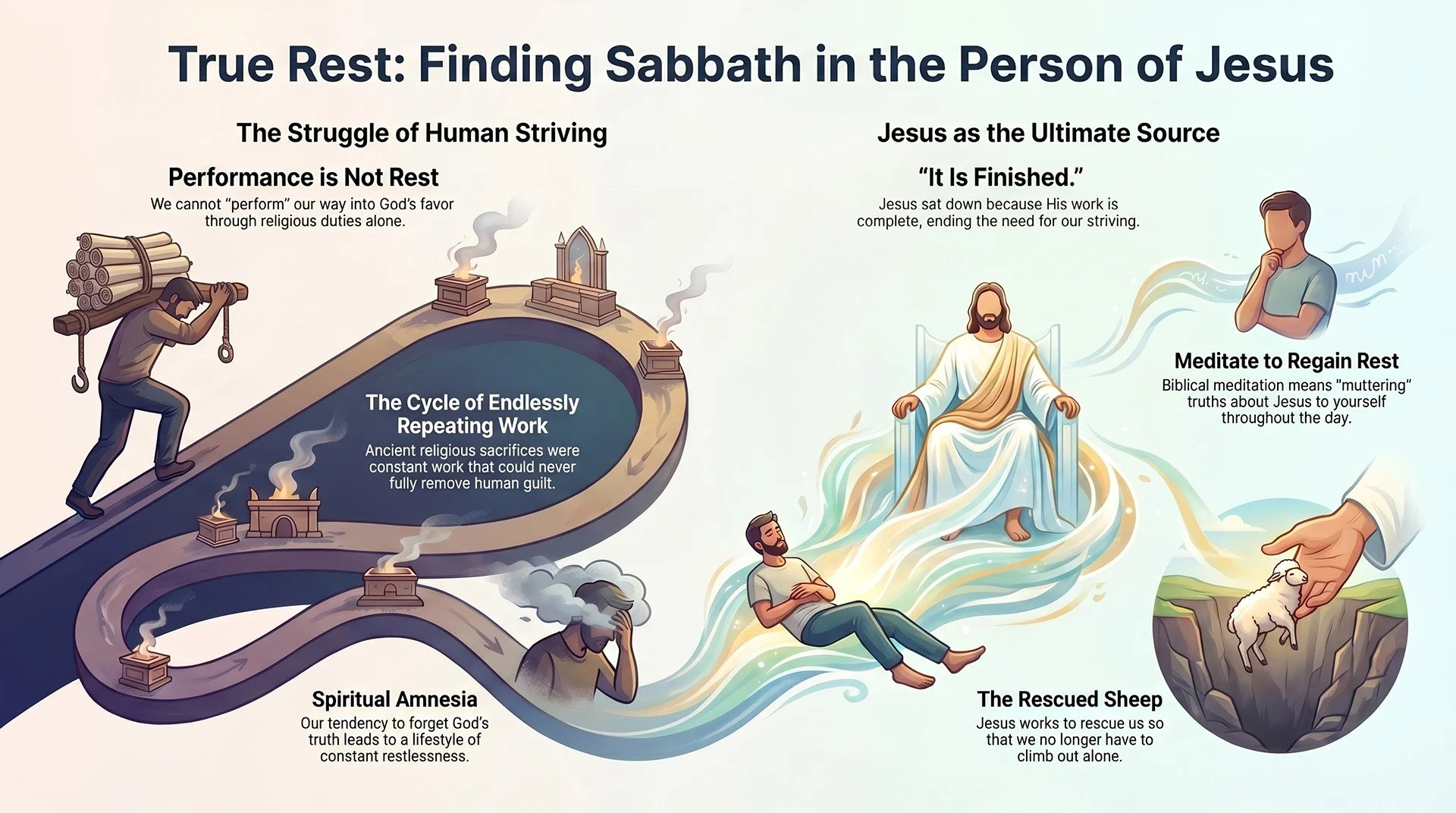
In this final installment of our Sabbath Rest series, we explore why Jesus is the ultimate answer to our restlessness and the true source of peace for His people. From the rhythm of creation to the finished work of the cross, the Scriptures point us away from our own performance and toward the One who has already accomplished everything. Join us as we learn to combat "spiritual amnesia" by meditating on Christ and finding the soul-deep rest we were always meant to experience.
Chapters
0:00 - Recap: The Concept of Sabbath and Rest
1:05 - Introduction to John 5: The Ultimate Answer
1:46 - Religious Leaders Miss Jesus, the Lord of Sabbath
2:27 - Why We Struggle to Find True Rest
4:05 - Jesus Christ: The True Source of Rest
4:55 - Meditating on Jesus for Soul Rest
5:40 - Overview: Tracing Jesus as Rest Through Scripture
6:00 - Jesus' Presence at Creation and Holy Sabbath
7:32 - The Exodus: Disobedience Prevents Entry into Rest
9:59 - The Continuous Work of the Sacrificial System
11:37 - The Law's Limitations: Sacrifices Cannot Perfect
13:50 - Our Tendency Towards Performance, Not Grace
16:16 - The Priest's Endless Duties vs. Jesus' One Sacrifice
18:21 - 'It is Finished': Resting in Jesus' Accomplished Work
19:08 - Looking to Jesus for Assurance and Rest
21:11 - Overcoming Busyness by Meditating on Jesus
22:26 - Jesus' Death: The Ultimate Offer of Rest
23:14 - Experiencing Rest in Your Daily Work
23:53 - Jesus Heals on Sabbath: Rescuing the Lost
25:05 - Conclusion: Rest at the Feet of Jesus
Deep Dive
Study Guide: Jesus as the Ultimate Source of Sabbath Rest
This study guide examines the theological and practical dimensions of Sabbath and rest as presented in the provided text. It explores the transition from the Old Testament understanding of rest to the fulfillment of rest found in the person and work of Jesus Christ.
--------------------------------------------------------------------------------
Part I: Short-Answer Quiz
Instructions: Answer the following questions in 2–3 sentences based on the information provided in the source text.
What is the literal meaning of the word "Sabbath," and how does it relate to the concept of rest?
According to the text, why is Jesus considered "pro-Sabbath" from the very beginning of time?
What specific factors prevented the Exodus generation from entering the rest God had promised them?
Why does the text describe the Old Testament sacrificial system as an "incomplete" form of rest?
How does Jesus’ statement "It is finished" change the requirement for human religious performance?
What is the biblical definition of "meditation" as described by the speaker, and how does it differ from modern cultural perceptions?
What is "spiritual amnesia," and how does it affect a person's ability to remain restful?
In the context of Jesus healing on the Sabbath, what does his concern for "lost sheep" reveal about the purpose of the day?
How does the speaker contrast the "Type A" personality's approach to God with the reality of God's grace?
What lesson can be drawn from the story of Mary and Martha regarding the "best thing" to do in the pursuit of rest?
--------------------------------------------------------------------------------
Part II: Answer Key
What is the literal meaning of the word "Sabbath," and how does it relate to the concept of rest? The word "Sabbath" means "to cease." While the terms Sabbath and rest have distinct nuances, they are often used interchangeably to describe the act of stopping one’s labor to be present with God.
According to the text, why is Jesus considered "pro-Sabbath" from the very beginning of time? Jesus was present at creation as "the Word" and, alongside the Father and the Spirit, established the final day of creation as a holy day of rest. Because he helped create the Sabbath, he embodies its true meaning and significance.
What specific factors prevented the Exodus generation from entering the rest God had promised them? The Exodus generation was prevented from entering the Promised Land because of their disobedience, rebellion, and unbelief. Their constant complaining in the wilderness and refusal to trust God’s delivery led to a 40-year delay during which that entire generation perished.
Why does the text describe the Old Testament sacrificial system as an "incomplete" form of rest? The system was a "shadow" that required sacrifices to be repeated endlessly, meaning worshippers were never fully cleansed of guilt or the awareness of sin. True rest was unattainable because people were constantly working to maintain their standing with God through the slaughter of animals.
How does Jesus’ statement "It is finished" change the requirement for human religious performance? This statement signifies the end of the sacrificial system and the need for humans to strive for God’s favor through performance. Because Jesus' sacrifice was "one for all time," believers can now rest in his completed work rather than their own religious duties.
What is the biblical definition of "meditation" as described by the speaker, and how does it differ from modern cultural perceptions? Biblical meditation means to "ponder deeply" or, in the original Hebrew, to "mutter" to oneself while thinking. Unlike modern perceptions that might view meditation as "floaty" or associated with other religions, the biblical version focuses on deeply processing who Jesus is and what he has done.
What is "spiritual amnesia," and how does it affect a person's ability to remain restful? Spiritual amnesia is the tendency of humans to quickly forget truths about God’s character and his promises. This condition makes it difficult for rest to "stick," requiring believers to regularly meditate on scripture to counteract the urge to return to striving and busyness.
In the context of Jesus healing on the Sabbath, what does his concern for "lost sheep" reveal about the purpose of the day? Jesus demonstrates that the Sabbath is a day for doing good and rescuing those in need, noting that a person is far more valuable than a sheep. It shows that the Lord of the Sabbath is more concerned with restoration and mercy than with rigid, legalistic adherence to rules.
How does the speaker contrast the "Type A" personality's approach to God with the reality of God's grace? A "Type A" approach focuses on performing religious duties perfectly to earn God's "well done," often leading to a cycle of failure and restarting. In contrast, grace teaches that God does not love people because they act lovely, but rather makes them lovely through the finished work of Jesus.
What lesson can be drawn from the story of Mary and Martha regarding the "best thing" to do in the pursuit of rest? While Martha was distracted by busyness and service, Mary chose the "best thing" by simply sitting at the feet of Jesus. This story illustrates that true soul rest is found in being present with Christ rather than being consumed by the "busyness" that often masks itself as necessity.
--------------------------------------------------------------------------------
Part III: Essay Questions
Instructions: Use the following prompts to develop deeper reflections or written assignments. (No answers provided).
The Evolution of Rest: Trace the concept of rest from the creation account in Genesis, through the wilderness wanderings of the Israelites, to the "sitting down" of Jesus in Hebrews. How does each stage clarify the human need for a divine source of rest?
The Perils of Performance: Analyze the speaker’s argument that all humans are "Pharisees inside." How does the drive to "perform" religious duties act as a barrier to experiencing the rest offered by Jesus?
Meditation as a Spiritual Discipline: Discuss the practical role of meditation (as defined in the text) in curing "spiritual amnesia." How does the act of "muttering" truths about Christ provide a practical solution to the "busyness" of modern life?
Shadow vs. Reality: Explain the relationship between the Old Testament sacrificial law and Jesus’ role as the "High Priest." Why does the author of Hebrews refer to the law as a "shadow" and Jesus as the "reality"?
The Tension of Rest in a Broken World: The text mentions that even vacations can be exhausting and that our minds often race during times of silence. Explore the speaker’s perspective on why "perfect" rest is difficult to achieve now and what the "fullness of time" promises for the future.
--------------------------------------------------------------------------------
Part IV: Glossary of Key Terms
Term
Definition
Sabbath
Derived from a word meaning "to cease"; a holy day set apart for rest and reflecting on one's relationship with God.
Meditation
The act of pondering deeply or "muttering" truths to oneself; a biblical practice used to anchor the soul in the identity and work of Jesus.
Spiritual Amnesia
The human tendency to forget spiritual truths and revert to self-reliance or striving.
Sacrificial System
The Old Testament requirement of repeated animal sacrifices used to signify repentance; described as a "shadow" of the ultimate sacrifice to come.
Lord of the Sabbath
A title for Jesus, indicating his authority over the day of rest and his role as its creator and fulfillment.
The Word
A biblical designation for Jesus (John 1), establishing his presence and divinity at the beginning of creation.
Busyness
Described as one of the primary challenges of the modern era; a tool used to prevent individuals from meditating on God.
Pharisee
Used metaphorically to describe the internal human impulse to believe that religious performance earns God’s favor.
Promised Land
A geographic and spiritual destination for the Israelites intended to be a place of rest, which the first generation failed to enter due to disobedience.
"It Is Finished"
The final words of Jesus on the cross, representing the completion of his work and the end of the need for human sacrificial striving.
Deep Dive Podcast
Resolutions of Jonathan Edwards
https://www.desiringgod.org/articles/the-resolutions-of-jonathan-edwards
Jonathan Edwards wrote 70 resolutions starting in December 1722 at age 19, continuing to add to them until August 1723 to guide his spiritual life and personal conduct. He instructed himself to read over these resolutions once a week and marked his progress in his personal diary alongside them.
The resolutions cover a comprehensive framework for Christian living, including:
God-Centered Purpose: Resolution 1 states, "Resolved, that I will do whatsoever I think to be most to God’s glory, and my own good... throughout my duration."
Time Management: Resolution 5 commands, "Resolved, never to lose one moment of time; but improve it the most profitable way I possibly can."
Moral Integrity: Resolution 7 advises, "Resolved, never to do anything, which I should be afraid to do, if it were the last hour of my life."
Emotional Control: Resolution 14 states, "Resolved, never to do anything out of revenge," and Resolution 16 warns, "Resolved, never to speak evil of anyone... upon no account except for some real good."
Spiritual Discipline: Resolution 28 resolves to "study the Scriptures so steadily, constantly and frequently, as that I may find, and plainly perceive myself to grow in the knowledge of the same."
Self-Examination: Resolution 37 requires him to "inquire every night... wherein I have been negligent, what sin I have committed, and wherein I have denied myself."
Other helpful resource:
https://redeemingproductivity.com/
Comprehensive Study Guide: The Theology and Practice of Biblical Rest
This study guide synthesizes the biblical imagery of divine provision found in Psalm 23 with the practical, theological insights regarding Sabbath and rest presented in the Mercy Church sermon transcript. It is designed to facilitate a deeper understanding of how to actively engage with the gift of rest.
--------------------------------------------------------------------------------
Part I: Short-Answer Quiz
Instructions: Answer the following ten questions in 2–3 sentences based on the provided texts.
According to the sermon’s analysis of Colossians 2:16, what is the primary rule regarding when a person should observe the Sabbath?
What is the distinction between working for salvation and "working out" salvation, and how does this apply to the practice of rest?
Explain the author of Ecclesiastes' perspective on the "sleep of a laborer" versus the sleep of the wealthy.
Based on the transcript, why is it necessary to have a "work week" in order for the Sabbath to be truly restful?
What does the imagery of "green pastures" and "quiet waters" in Psalm 23 suggest about the nature of God’s guidance?
The speaker describes a "split Sabbath" he and his wife attempted when their children were young. Why did they find this arrangement stressful rather than restful?
How did the historical nation of Israel integrate rest into their national rhythm beyond just a weekly Sabbath?
According to the Gospel of Mark, how did Jesus respond when the disciples found Him in a solitary place after a period of intense healing and ministry?
What is the "phrase that pays" regarding the process of learning to rest, and what does it imply about the learner’s expectations?
How should a person choose their Sabbath activities if they spend their work week primarily performing mental labor, such as staring at a computer?
--------------------------------------------------------------------------------
Part II: Answer Key
The primary rule is that the Sabbath does not have to be restricted to Saturday (Shabbat). Following the teaching of the Apostle Paul, the sermon emphasizes that while a 24-hour rhythm of rest is biblical, the specific day—whether it be Saturday or a Tuesday—should not be used as a basis for judging others' religious devotion.
Working for salvation is the incorrect belief that one must earn forgiveness, whereas "working out" salvation is the process of living out the relationship already entrusted to the believer through Christ. Similarly, rest is a gift from God, but believers must "work out" the practical steps and disciplines required to learn how to rest well in their daily lives.
Ecclesiastes 5:12 states that the sleep of a laborer is "sweet," regardless of how much they have to eat, because their hard work prepares them for rest. Conversely, the abundance of the wealthy can lead to anxiety or a preoccupation with maintaining resources, which ultimately "permits them no sleep."
A day of rest assumes that work has occurred during the rest of the week; without the "bad news" of labor or intentional effort, the "good news" of rest loses its meaning and rhythm. If a person "sort of" rests and "sort of" works throughout the week, the Sabbath will not feel distinct or truly sweet because the necessary contrast has not been established.
This imagery suggests that God, as a shepherd, provides total refreshment and peace for the soul. It indicates that divine guidance leads to places of restoration and safety ("right paths") where the believer lacks nothing and can "lie down" without fear.
They found it stressful because they had only a four-hour block of time and felt immense pressure to "force" rest within that limited window. The speaker realized that trying to "check all the boxes" of restful activities (hiking, walking dogs, listening to podcasts) in a short period actually prevented true ceasing.
In addition to the weekly Sabbath, Israel celebrated seven annual festivals to refocus on God and observed a sabbatical year every seven years to reset the land. Every fifty years (seven times seven years), they practiced a comprehensive reset of the land and society to acknowledge God’s sovereignty over their lives.
Jesus did not apologize for withdrawing; instead, He told His disciples that they needed to move on to other towns to preach the kingdom of God. This demonstrated that His time in solitary prayer was essential for refocusing on His primary mission rather than being consumed by the immediate demands of the crowd.
The phrase is "direction, not perfection." It implies that finding true rest is a developmental process involving success and failure, and that believers should give themselves grace to try, fail, and try again rather than giving up if they do not rest perfectly on the first attempt.
The sermon suggests following the recommendation that those who work with their minds during the week should work with their hands on their day of rest. Engaging in physical activities like gardening or mowing the lawn provides a sense of completion and "wrapping up" that abstract mental labor often lacks.
--------------------------------------------------------------------------------
Part III: Essay Questions
Instructions: Use the provided sources to develop comprehensive responses to the following prompts. (Answers not provided).
The Shepherd’s Tools of Comfort: Analyze the imagery in Psalm 23 regarding the "rod and staff" and the "table prepared in the presence of enemies." How do these elements provide comfort and a sense of "Sabbath" even when the believer is walking through the "darkest valley"?
Rest as an Act of Faith: The transcript suggests that Sabbath is "a sign to us" and "a sign to others." Discuss how choosing to cease from labor functions as a public and private declaration of faith in God’s provision.
The Role of Intentional Reflection: The speaker provides a detailed system for reflecting on various life "values" (spiritual disciplines, family, work, etc.) during rest. Argue for the importance of "slowing down enough to consider your life" as a component of biblical rest, rather than viewing rest solely as inactivity or napping.
The Theology of Refreshment: Compare the concept of God refreshing the soul in Psalm 23 with the sermon’s principle that rest should begin by "recentering on who God is." Why is spiritual reconnection considered the foundation for physical and emotional restoration?
Individualized Restoration: The sermon highlights that what is restful for one person (e.g., the woods) may not be restful for another (e.g., the beach). Explore the implications of this for the Christian community, particularly regarding the avoidance of legalism and the promotion of personal "active participation" in the gift of rest.
--------------------------------------------------------------------------------
Part IV: Glossary of Key Terms
Term
Definition
Anoint
The act of pouring oil on the head, as described in Psalm 23:5, signifying divine favor, blessing, and abundance ("my cup overflows").
Ceasing
A core component of the biblical Sabbath; the intentional act of stopping work or labor to engage in rest.
Direction, not Perfection
A principle used to describe the process of learning to rest; emphasizing steady progress and grace over the demand for immediate, flawless execution.
Quiet Waters
Imagery from Psalm 23 representing the peace and soul-refreshment provided by God’s guidance.
Rod and Staff
The tools of a shepherd used to guide and protect sheep; in Psalm 23, they symbolize the comfort and security found in God’s presence.
Sabbath (Shabbat)
A day of rest and ceasing from labor, traditionally observed on the seventh day (Saturday), but described in the sermon as a flexible 24-hour rhythm of rest and refocusing on God.
Salvation
Forgiveness for sin accomplished by Jesus; the transcript distinguishes between the gift of salvation and the "work" of living it out.
Shepherd
A biblical metaphor for God’s role as a provider, guide, and protector who ensures His people "lack nothing."
Values (System of)
A reflective tool mentioned in the sermon involving categories like spiritual disciplines, family, and work used to evaluate one's life during the Sabbath.
Work
Defined in the context of the sermon as "intentional effort towards some particular purpose," which provides the necessary contrast for rest.
