Daniel - Holiness & Hope
By focusing on both present conduct and future expectations, the series offers a strategy for staying optimistic despite cultural friction. Ultimately, the material serves as a guide for navigating the tension between sacred commitments and a secular world.
Deep Dive Podcast
Study Guide: Holiness and Hope in a Hostile Culture
This study guide is designed to review the core concepts presented in the sermon on the first chapter of the Book of Daniel, focusing on how to live with holiness and hope within a culture that may be opposed to the ways of God.
Short-Answer Quiz
Instructions: Answer the following questions in 2-3 complete sentences, drawing your information directly from the source material.
According to the sermon, what is the definition of "culture"?
What is the central tension believers face when engaging with culture, and what are the dangers of each extreme?
What is the historical context for the Book of Daniel as described in the sermon?
Explain the process of "intentional inculturation" that the Babylonians used on Daniel and his friends.
Why did the chief official change the names of Daniel, Hananiah, Mishael, and Azariah?
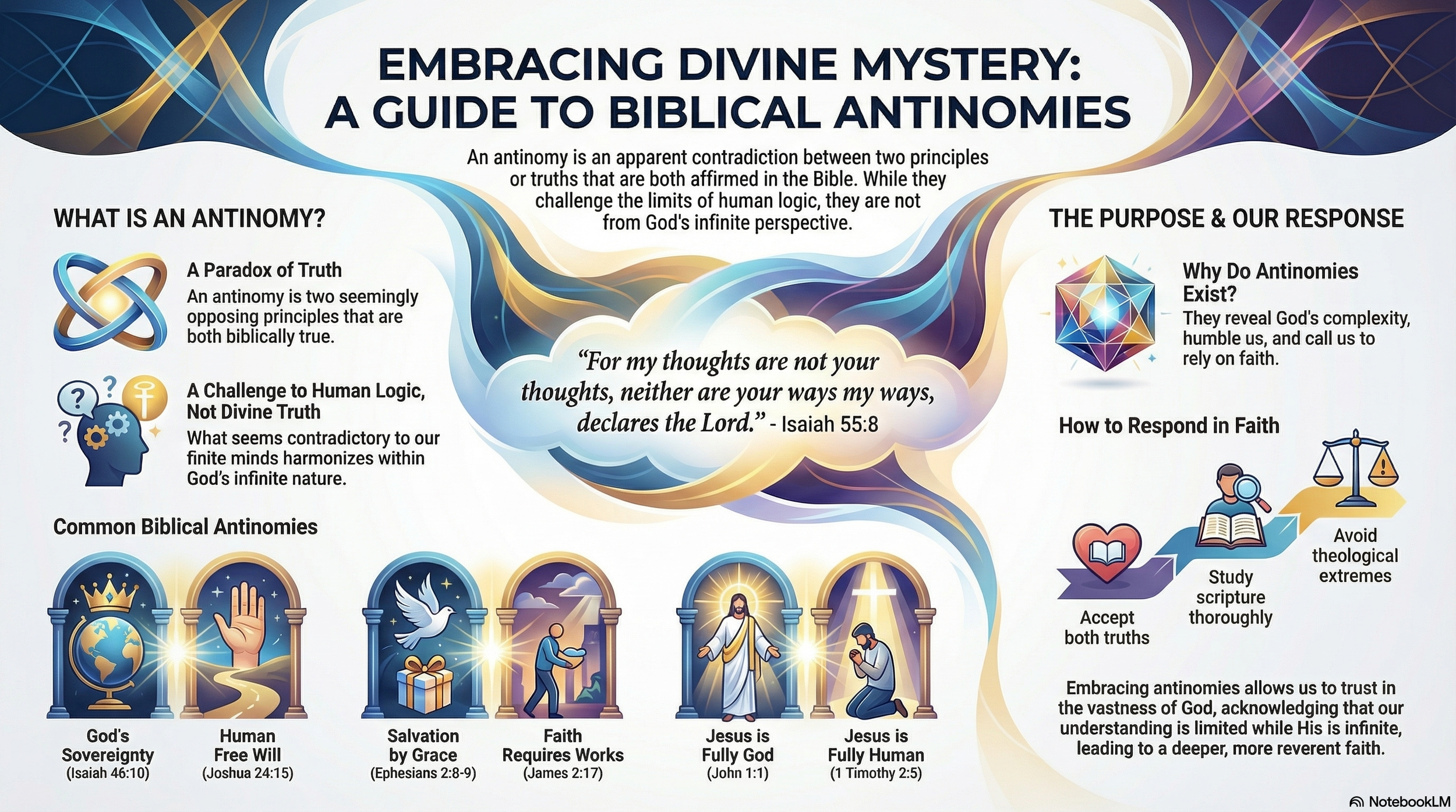
The sermon presents the relationship between God's sovereignty and human freedom as an "antinomy." What does this term mean in this context?
What specific reasons did Daniel have for resolving not to "defile himself" with the royal food and wine?
How did Daniel respectfully propose a solution to the chief official regarding the royal food?
What was the direct, supernatural result of Daniel and his friends' ten-day test of eating only vegetables and water?
In what two ways does the sermon suggest that Daniel's story serves as a foreshadowing of Jesus?
--------------------------------------------------------------------------------
Answer Key
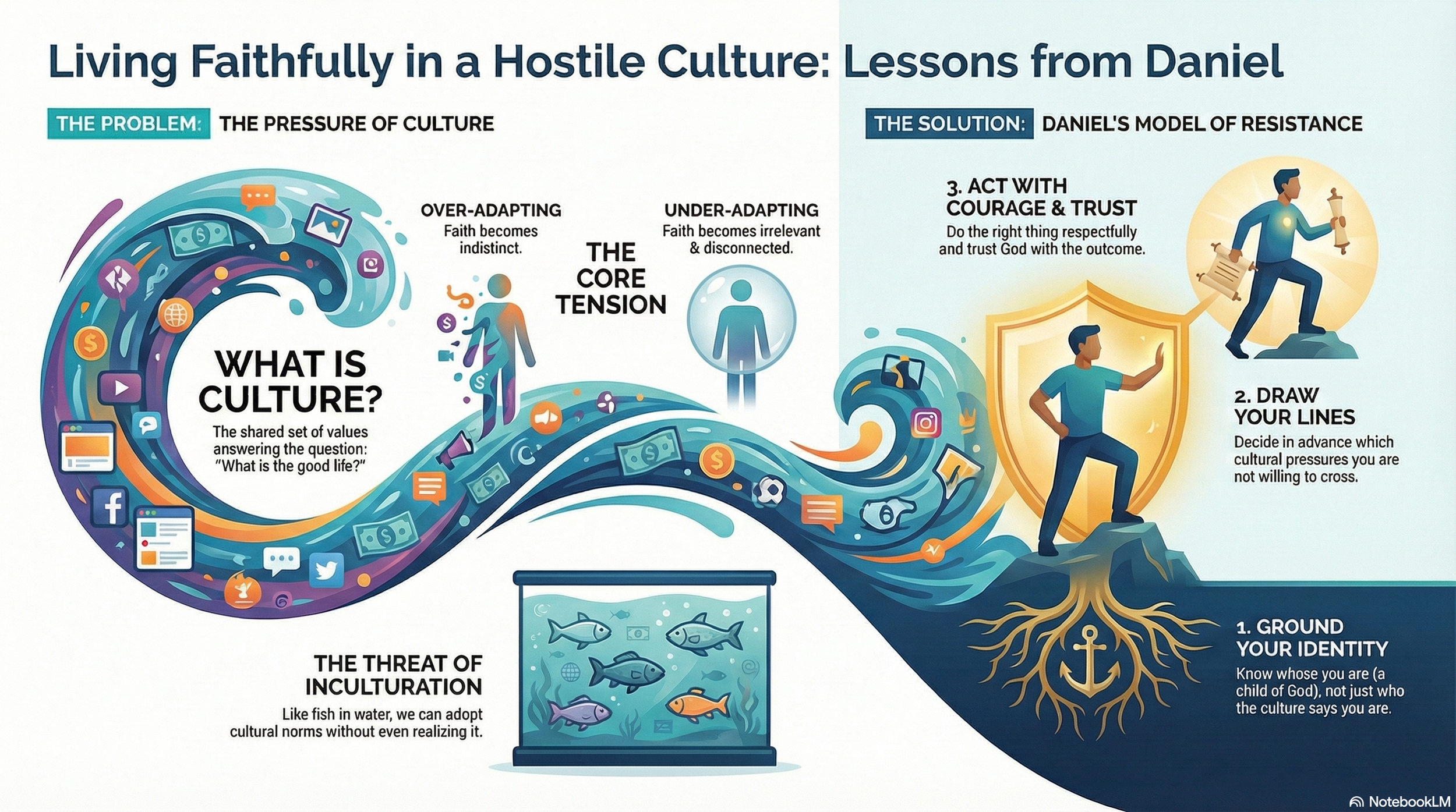
Culture is defined as the shared set of values in a particular time and place that attempts to answer the question, "What is the good life?" These shared values influence how people think about all areas of life, including food, money, technology, and relationships.
The central tension is whether to "over-adapt" or "under-adapt" to the culture. Over-adapting results in believers not looking any different from the culture and losing their "salt and light" quality, while under-adapting leads to becoming irrelevant, disconnected, and unable to bridge the gap to share the gospel.
The story begins immediately after Babylon, under King Nebuchadnezzar, attacks and sacks the city of Jerusalem. The Babylonians took sacred items from the temple in Jerusalem and captured prisoners, including young men from the Israelite royal family and nobility who become the story's central characters.
The Babylonians' plan was to take the most capable young Israelites and train them for three years in Babylonian language and literature. This slow process was designed to teach them the Babylonian culture, gods, and way of living so they would turn their backs on their own Hebrew culture and become useful for the king's service.
Their names were changed to reshape their identities and connect them to Babylonian religion and gods. For example, Shadrach means "illuminated by the sun God" and Abednego means "the servant of Nebo." This was a key part of the inculturation process to make them think in a Babylonian way.
An "antinomy"* is described as a concept where two things that seem to make sense on their own must find a way to combine. In this context, it refers to the biblical paradox of God sovereignly weaving a story together while humans simultaneously make their own free decisions. (https://www.answerthebible.com/what-is-antinomy/)
Daniel considered the food defiling for several reasons. The food was likely sacrificed to idols and was not kosher according to Hebrew law. Furthermore, sharing a meal by Eastern standards was a covenant of friendship, and eating the king's food would have signified that Daniel was "all in" with the Babylonian culture.
Daniel respectfully proposed a test rather than simply refusing. He asked the guard to test him and his friends for ten days, giving them nothing but vegetables and water. At the end of the ten days, the guard could compare their appearance to the men eating the royal food and act accordingly.
At the end of ten days, Daniel and his friends looked healthier and better nourished than the young men who ate the rich royal food. This was presented as a miracle, as a vegetable-only diet would not normally produce such results compared to the king's fare. As a result, the guard took away their choice food and gave them vegetables instead.
The sermon suggests Daniel foreshadows Jesus as one who would stand against the kingdoms of the world and put his full trust in his Father in heaven. Additionally, just as things looked dark for Daniel before the ten-day test proved successful, things looked dark for Jesus for three days in the grave before he was resurrected, conquering even death.
--------------------------------------------------------------------------------
Essay Questions
Instructions: The following questions are designed for deeper reflection. Use the concepts from the sermon to construct a thorough, well-reasoned response.
The sermon uses the analogy that people are like "fish in water" when it comes to culture. Elaborate on this analogy. How does it explain the challenges of discerning and consciously evaluating the cultural norms we absorb?
Discuss the statement, "language shapes our culture, and then that culture shapes how we see reality." Using the examples from the sermon (mental health language, Babylonian literature), explain how this principle works and why it was a critical component of Nebuchadnezzar's strategy.
Explore the tension between the "sovereignty of God" and the "freedom of man" as described in the sermon. Why is this concept, referred to as an "antinomy*," important for understanding the events in Daniel chapter 1 and for a believer's own life?
Analyze Daniel's method of cultural engagement when he refused the king's food. How did his approach balance conviction (drawing a line he would not cross) with wisdom and respect? What can be learned from his model?
The sermon emphasizes the importance of knowing "whose you are" as a foundation for knowing "who you are." Explain this concept and detail how having a firm identity in God, as illustrated by the story of Maximus in Gladiator, provides the strength to stand firm when a hostile culture pushes against you.
--------------------------------------------------------------------------------
Glossary of Key Terms and Figures
Term / Figure
Definition from Source Context
Antinomy*
The theological term used to describe when two things that seem to make sense on their own have to find a way to combine, such as the freedom of man and the sovereignty of God. Antinomy refers to a contradiction or paradox between two equally valid principles or truths. The word comes from the Greek anti meaning “against” and nomos meaning “law.” In theology, an antinomy exists when two principles or doctrines seem to contradict each other, yet both are found to be true in the Bible.
Ashpenaz
The chief of King Nebuchadnezzar's court officials, ordered to bring the Israelite young men into the king's service and oversee their training.
Babylon
The kingdom, ruled by Nebuchadnezzar, that attacked and conquered Jerusalem. The setting for the Book of Daniel.
Culture
The shared set of values in a particular time and place that is trying to answer the question, "What is the good life?"
Daniel
A young man from Judah whose name means "God is my judge." He is a central character who resolves to live in holiness within the hostile Babylonian culture.
Defile
A religious term used by Daniel to describe what would happen if he ate the royal food and wine, signifying a violation of his commitment to God.
Holiness and Hope
The title of the sermon series, encapsulating the theme of how to live in holiness now while maintaining hope for the future in a hostile culture.
Inculturation
The intentional and often slow process of teaching someone to adopt the values, gods, and ways of living of a new culture. Nebuchadnezzar's three-year training program for the Israelites is an example.
Jehoiakim
The king of Judah at the time of Nebuchadnezzar's siege of Jerusalem. His name means "God raises up," though he was put into leadership by Egyptian authorities and was not a great king.
Nebuchadnezzar
The king of Babylon who besieged Jerusalem, captured Jehoiakim, and initiated the inculturation of the Israelite nobles.
Over-adapting
The act of taking on everything a culture offers. This results in looking no different from the culture and failing to be "salt and light."
Salt and Light
A phrase from Jesus describing what his followers are supposed to be in the culture. Over-adapting to culture causes one to lose this quality.
Under-adapting
The act of pushing back against everything a culture does. This results in becoming completely irrelevant, disconnected, and unable to engage with people.
Names (New)
The new Babylonian names given to the four Hebrew men to reshape their identity and tie them to Babylonian gods.
Belteshazzar
Shadrach
Meshach
Abednego
*More about “Antinomy”
(See https://www.answerthebible.com/what-is-antinomy/ -> “Understanding Antinomies”)
When faced with such theological antinomies, here are some principles to keep in mind:
Study Scripture thoroughly and recognize that both principles are taught there.
Avoid going to extremes that deny one side of the paradox in favor of the other.
Don’t assume human logic can fully reconcile two seemingly contradictory truths.
Accept the tension by faith, trusting that God understands perfectly.
Affirm the mystery, knowing that in heaven we will understand fully.
Though challenging to our finite minds, biblical antinomies are an opportunity to humbly acknowledge our limitations, trust God more deeply, avoid theological extremes, and look forward to eternity when all will be understood clearly.